English speaking torture experts, Azov savagery and Satanic ritual VANESSA BEELEY Stratpol (pro-Russian media) recently interviewed Laurent Brayard, a French ...Read more
Uncle Sam heads for the exit in Ukraine leaving Europe in a panic
While Macron threatens boots on the ground to shore up a failing Ukraine, German generals’ leaked audio proves that European forces are already there.
Proletarian writers
Subscribe to our channel
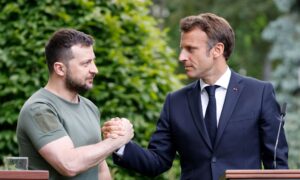
Emmanuel Macron’s repeated assertions that France wants to lead an ‘expeditionary force’ into Ukraine to help back up the Ukronazis’ flagging frontline forces is one of many signs of the deep panic that is spreading through European capitals. Junior imperialist powers including Britain, France and Germany have sacrificed their economies and used up their arsenals in the US-led proxy war against Russia only to find that the instigators of all the trouble, understanding that defeat is imminent, are preparing to pack up and head home.
French president Emmanuel Macron’s showy diplomatic efforts to whip the rest of Europe into line against Russia have so far only succeeded in emphasising the divisions within the western camp and by contrast the steady progress Russian forces are making towards their stated objectives in Ukraine.
The French president’s complaints about other (non-specific) European Union members being “cowards” for being lukewarm in their support for the US-backed junta in Kiev, coupled with broad hints that French troops could end up with their boots on the ground in Ukraine, have succeeded only in annoying France’s allies and revealing President Macron’s vaunted policy of ‘strategic ambiguity’ to be so much hot air.
Macron went on French television to claim that France was a “force for peace” standing behind Ukraine, and to warn: “If we let Ukraine lose this war, then for sure Russia will threaten Moldova, Romania and Poland.”
Invited by a French newspaper to explain his Ukraine policy, Macron wound up contradicting himself, by turns threatening and placating Russia and finally lapsing into complete incoherence. “Maybe at some point – I don’t want it, I won’t take the initiative – we will have to have operations on the ground, whatever they may be, to counter the Russian forces. France’s strength is that we can do it.”
So that’s clear then: he doesn’t want to send French troops into Ukraine, but there will have to be operations on the ground at some point, but Macron won’t take the initiative, but France is strong enough to send troops, or maybe not …
Moscow’s response to this tedious rigmarole is unambiguous: if French troops enter Ukraine, under whatever pretext, they will be recognised as invaders and destroyed.
German generals spill the beans
Meanwhile, whilst Germany’s chancellor Olaf Scholz may bridle at the suggestion of French boots on the ground, fearing that this will bounce the rest of Europe into an unwelcome face-off with Russia, it turns out that his own generals are merrily chatting on an insecure line about how many missiles it would take to blow up the Kerch bridge to Crimea and how many British troops are already on the ground in Ukraine.
“Released on Friday by the editor of the Kremlin-controlled news channel RT, Margarita Simonyan, the audio recording – confirmed as authentic by Germany – captures Luftwaffe officers discussing how Berlin’s Taurus missiles could be used to try to blow up the Kerch Bridge connecting Russia with occupied Crimea.
“During the conversation, Lt Gen Ingo Gerhartz, the head of the Luftwaffe, describes how Britain works with Ukraine on deploying Storm Shadow missiles against targets up to 150 miles behind Russian lines.
“‘When it comes to mission planning,’ the German commander says, ‘I know how the English do it, they do it completely in reachback. They also have a few people on the ground, they do that, the French don’t.’
“Reachback is a military term to describe how intelligence, equipment and support from the rear is brought forward to units deployed on the front, but Gerhartz suggests the British approach is deeper, involving support on site.” British soldiers ‘on the ground’ in Ukraine, says German military leak by Dan Sabbagh and Kate Connolly, The Guardian, 4 March 2024)
Chancellor Scholz has excused his reluctance to furnish Kiev with long-range German-made Taurus missiles by arguing that this cannot happen without German boots on the ground, which is a red line that cannot be breached. But the garrulous Luftwaffe know different: “the French don’t” have people on the ground.
Europe in a panic as the USA heads for the exit
The EU accomplices in this American war were happy to swear allegiance to Ukraine so long as the USA had their backs and the dollars and the weapons kept on flowing. Even when the sanctions war against Russia blew up in their faces, the gutless EU still kowtowed to Washington, preferring to empty their arsenals of weapons and deindustrialise their economies sooner than consult their own national interests.
But now that it becomes clear that the USA is racing ahead of Europe when it comes to disengaging from the Ukraine war, Europe is beginning to wake up to the catastrophic mess it has helped to create.
US president Joe Biden may still believe that Ukraine is winning the war and the moon is made of green cheese, but far better indices of the national mood in the USA are the blocking by Congress of the $60bn US military aid package for Ukraine and the sacking of the foremost architect of the failed Ukraine war, Victoria Nuland.
Her last job was as acting deputy secretary of state covering the recently retired Wendy Sherman. Nuland looked set to take on the post permanently, but was pipped at the post by Kurt Campbell. Campbell, who was the architect of President Barack Obama’s ‘pivot to Asia’ is still dining out on the book he wrote about the rationale for that shift back in 2016.
The message coming from Washington to its European allies is clear: you sort out the mess on your continent whilst we pursue our interests elsewhere.
Russia’s plain-speaking foreign office spokeswoman Maria Zakharova was in no doubt as to the significance of Ms Nuland’s departure.
“It is simple – the failure of the anti-Russian course of the Biden administration. Russophobia, proposed by Victoria Nuland as the main foreign policy concept of the United States, is dragging the Democrats to the bottom like a stone.”
And it is not only the russophobe administration of Joe Biden that is sinking like a stone, but the whole prestige of the USA is sinking with them, as the world looks on aghast at the barbarism of America’s proxy war, fought indeed to the last drop of Ukrainian blood.
Desperation in Kiev
Reports coming out of Ukraine reveal the blind panic of the Kiev junta as the realisation dawns that they are simply running out of bodies and are reduced to sending press gangs on to the street to snatch reluctant recruits.
According to the Washington Post: “President Volodymyr Zelensky and his top military commanders have failed so far to come up with a clear plan to conscript or recruit many thousands of new soldiers critically needed to defend against Russia’s continuing attacks.
“Zelensky’s inability to forge a political consensus on a mobilisation strategy – despite months of warnings about a severe shortage of qualified troops on the front – has fuelled deep divisions in Ukraine’s parliament and more broadly in Ukrainian society.
“It has left the military relying on a hodgepodge of recruiting efforts and sown panic among fighting-age men, some of whom have gone into hiding, worried that they will be drafted into an ill-equipped army and sent to certain death given that aid for Ukraine remains stalled in Washington.
“The quandary over how to fill the ranks has confronted Zelensky with perhaps the greatest challenge to his leadership since the start of the February 2022 invasion. The lack of a clear mobilisation strategy – or even agreement on how many more troops Ukraine needs – factored into Zelensky’s dismissal of his top general in February, but the new commander in chief, Oleksandr Syrskyi, so far has brought no new clarity.
“Syrskyi has been tasked with auditing the existing armed forces to find more combat-eligible troops, after Zelensky’s office recently announced that of the one million people who have been mobilised, only about 300,000 have fought at the front lines.
“But nearly a month after his promotion, no one in the military leadership or the presidential administration has explained where those 700,000 are – or what they have been doing.” Zelensky in bind over how to draft more troops as Russian forces advance by Siobhán O’Grady and Serhii Korolchuk, 4 March 2024)
And while the Ukrainians count the cost in lives, German workers count the cost in redundancies and lay-offs. According to Bloomberg, Germany is in recession and the Bundesbank says Germany is in a six-month slump. (Germany is in recession due to first-quarter slump, survey shows, Bloomberg, 18 March 2024)
Other Bloomberg headlines are uncompromising: “German factory orders slump in new sign of economic slowdown” and “Germany’s days as an industrial superpower are coming to an end”.
As Germany waves farewell to cheap gas from Russia and easy access to an expanding Chinese market, the full damage done to the economy by setting Germany’s national interest in second place to her shield duty for Uncle Sam is becoming clear.
Book: Britain’s Perfidious Labour party by Harpal Brar
An essential history for every sincere worker who wishes to make sense of the political landscape in Britain and find an effective way forward.
Introduction by Ranjeet Brar to Harpal Brar’s text
It remains an article of faith to many British workers, and much of the British left, that the Labour party is the mass party of the working class. The Labour party was founded by the British trade union movement, and it is widely believed that the Labour party brought us the National Health Service and the welfare state. These two statements – one a half truth, the other a fabrication – are generally considered enough to carry the argument.
And yet it is increasingly hard to overlook the fact that with every passing year, particularly since the mid-1970s, British society is becoming ever more inequitable and unjust. Economic crisis, war, unemployment, poverty, destitution, environmental degradation, physical and mental disease, worsening state education for the mass of the working class, the disintegration of our once highly-prized health service, the prevalence of degenerate culture, drugs and street crime – a deep malaise is afflicting Britain, just as surely as it afflicts the wider world.
It is the malaise of capitalism. Of individualism. Of inequality and want, at precisely the moment when the means to alleviate suffering and eliminate want are superabundant, owing to the vast productivity of human labour employing modern technology, and a previously undreamt-of power (hugely enhanced by the latest innovations in microchip technology) to gather, analyse and share vast amounts of scientific, technical and administrative data.
A polarised nation and a polarised world
Britain in 2023 has a ruling elite, composed of financiers and businessmen, comprising far less than one percent of the population, who have so enriched themselves that they own more than the poorest 80 percent of the population.
Just 25,000 landowners – typically scions of the aristocracy who have interlocked their wealth with corporations – own more than half of Britain’s land. By contrast, the combined landholding of all private homeowners occupies less than 5 percent of Britain’s land.
In the decade and a half of austerity since the 2008 economic crisis, capital has been further concentrated and the living standards of the working population have fallen precipitously. Housing and rental costs have gone up with stock market speculation even as productive employment and wages have fallen, precipitating a housing crisis that is set to grow as more and more people default on rental and mortgage payments.
Current estimates show that five million workers in Britain are destitute, with incomes sinking further and further below subsistence level as a result of inflation caused by money-printing, mammoth energy price-hikes, supply chain disruption caused by Covid-19, imperialism’s proxy war of aggression in Ukraine, and the blowback from sanctions imposed on Russia (and elsewhere).
The Marmot review, ten years on from its initial report that sounded the alarm on widening health inequalities, actually found in February 2020 that the life expectancy of the British working class is falling, particularly in the economically depressed north – despite Britain still being the ‘sixth-richest’ nation on earth. And that was before the economic depression of 2020 had struck the global stock-market and caused a 20 to 30 percent contraction of the global economy during the year of the coronavirus pandemic.
We live in a world in which a tiny handful of rich individuals, already multibillionaires, are close to becoming trillionaires; this tiny clique of six or seven multibillionaires has more wealth than the poorest half of humanity – than three and a half billion people combined.
Labour’s role in the struggle between workers and capitalists
We cannot overlook the fact that the Labour party, in government and in opposition, has played a significant part in shaping this state of affairs. Rather than simply asserting that ‘the election of a Labour government under pressure from the left’ is an answer to all social ills, as is the custom of many, this slim volume aims to assess the real history of the formation of Labour party and its true role.
We shall briefly examine the people and the class forces that brought it into being, the struggles it faced and, most importantly, the role that its leadership consistently played in the crucible of class struggle that was the 20th century.
It should not be forgotten that the Labour party was formed and cut its teeth in a period of fierce class struggle and interimperialist conflict. The twentieth century witnessed the unparalleled horrors of two world wars – wars that caused the deaths of one hundred million workers – waged over the question of the primacy of the great powers and their right to exploit the workers and resources of all countries.
The first world war brought on its heels the victorious October Revolution in Russia, in which the workers of a major imperialist nation, covering fully one-sixth of the world’s territory, for the first time took political power and economic wealth into their own hands in order to forge their own destiny, abolishing exploitation and fratricidal strife, and replacing them with a new socialist economic and political order. In so doing, they set a mighty example that further fomented class struggle and the battle for workers’ rights and workers’ power in all nations.
The October Revolution ended the first world war, but that terrible interimperialist conflict also precipitated the fall of the social formations that had determined human destiny in the preceding centuries. It brought about the immediate collapse of four great empires – the tsars of Russia, the Ottoman sultanate of Turkey and the middle east, the Austro-Hungarian Hapsburg monarchy and the Prusso-German Hohenzollern dynasty. These empires fell to revolution, their social fabric crumbling amidst their defeats in battle; but the white heat of conflict also precipitated the international rise of the revolutionary working class and national-liberation movements that would see, at least in their old form, the end of the British and the French empires.
The construction of Soviet socialism posed a mortal challenge to the capitalist order, with the rise of the socialist world and the growing influence of the Third International (the communist international, or Comintern). The Chinese Revolution and the Indian independence movement threatened the old world order, in particular the material interest of the British empire.
The major imperialist powers saw their salvation from communism in the rise of Hitlerite fascism, which they aided and abetted in every possible way, hoping to turn Germany against their principal adversary – the revolutionary Soviet Union. The Spanish civil war was the stage rehearsal for World War Two, and the British working class was among many that sent volunteers to join the International Brigades, confronting the fascists of General Francisco Franco, while the Crown (the British monarchy) and significant sections of the British and US ruling classes sided with Nazism. We examine the attitude of the Labour party to those struggles.
When the second world war ended with the heroic victory of the USSR and China over fascism, in temporary military ‘alliance’ with Anglo-American imperialism, the Soviet Union, its Communist party and its leadership’s prestige throughout the globe was immense, and a new wave of socialist governments were brought into being across central and eastern Europe, followed shortly by the epic victory of the Chinese Revolution in 1949.
The cold war
Notwithstanding the wartime alliance between the Soviet Union, the USA and Britain – a victory for Soviet diplomacy, the herculean courage and energy of the Soviet working people, and the military strength and valour of the Red Army, rather than any change of heart on the part of the predatory British and US ruling classes – the most intense hostility was fostered in postwar USA, Britain and the capitalist world they led to ‘the Russians’. This was a reinforcing and continuation of the vehement anticommunist struggle that was waged by the British and US ruling classes throughout the 20th century.
Former prime minister Winston Churchill’s 1946 ‘iron curtain’ speech (a term he quietly pilfered from Joseph Goebbels’ Nazi propaganda) was delivered to an audience in Fulton, Missouri, while on a tour of the USA, and signalled the transition to the cold war. This was nothing other than a heightening of the class struggle, in national form, and drawn along the demarcation lines at the closing of military operations of the second world war.
Nato, in the creation of which Britain’s Labour party, under the leadership of Clement Attlee, played a leading role, was formed as an aggressive imperialist alliance, initially set up with the mission of opposing the socialist countries (the liberated working class). It was also, as has now become clear to all since the demise of the USSR, to act as an alliance of the imperialist brigands against all independent nations.
In the face of the stubborn, prolonged and earnestly fought social and political challenge to the old exploitative order, and while social unrest and industrial conflict was also raging in Britain, where did the Labour party leadership take its stand in this herculean conflict? In fact, the actions of the Labour party’s leaders and the Trades Union Congress (TUC) general council during the 1926 general strike had already revealed the trajectory and set the course for the later development of Britain’s labour movement for the following century.
In this pamphlet, we examine these key historical facts and draw conclusions accordingly.
Thatcherite neoliberalism
Margaret Thatcher’s government was installed by Britain’s rulers to enact a policy of deindustrialisation in favour of the unbridled dominance of the banking and financial service sectors. This fundamentally changed Britain, mirroring similar reforms in the USA under the regime of Ronald Reagan. Swathes of manufacturing jobs evaporated across the country. Or, more precisely, capital was exported. Britain radically downsized its manufacturing base, embracing its role as an international banker, living by ‘clipping coupons’, making superprofits from exploiting ultra-low wage workers overseas. [1]
While a privileged section of British workers were given considerable crumbs from the table during this looting and plundering process, the majority were largely excluded from the robber-barons’ feast. Moreover, having lost their productive roles, increasing numbers were cast unwittingly into a degrading and parasitic life. As the great mines, mills and factories of Britain were abandoned, as the country’s steel foundries and shipbuilding yards were dismantled, many working-class communities and social institutions were also destroyed.
Life on the dole was, for millions, quite literally a scrapheap of unemployment, [2] without hope of self-improvement and with no prospect of making a meaningful contribution to society. There was widespread anger with capitalism. And this conflict came to a head during the great miners’ strike of 1984-5, heroically led by National Union of Mineworkers (NUM) leader Arthur Scargill.
Yet that righteous anger of the working class, channelled and directed by the Labour party, was transformed into anger only with ‘the Tories’ – with Margaret Thatcher, with her successor John Major, with Rupert Murdoch’s ‘lying press’ and with the Tory party’s ‘18 years rule’. [3] The breaking of the unions that followed the miners’ strike facilitated the introduction of widespread ‘flexible’ working and zero-hour contracts in poorly-paid service sector jobs, bringing with them the further erosion of working-class living standards.
A shot in the arm to the ailing international capitalist order was given by the collapse of the Soviet Union, [4] which in turn created conditions for a renaissance of classical Anglo-American imperialism; the ability of city financiers to intensify their economic exploitation both of the less developed oppressed countries and of the former Soviet nations. Far from receiving the promised ‘peace dividend’, workers in the west found that military spending skyrocketed.
Today, the USA alone spends $850bn a year on armaments, and the world has suffered a fresh wave of adventurist and genocidal colonial invasions, [5] launched under US president George H Bush’s slogan of a ‘New World Order’ to enforce Anglo-American imperialism’s economic primacy.
‘National’ wealth increased, but it was drawn primarily from the profits of the financiers in the City of London, at the expense of the further impoverishment of the formerly colonised peoples of Asia, Africa and Latin America, and was concentrated in ever fewer hands.
The majority of Britain’s ‘left’ outside Labour during this period was typified by the Trotskyite Socialist Workers party (SWP), which greeted the defeat of the rabid reactionary Neil Kinnock (Labour party) by John Major (Conservative party) in the 1992 general election as a national calamity. This was the same Trotskyite SWP that had greeted the fall of the Soviet Union, and the trail of rabid reaction that this fall set in tow, as a victory for ‘real socialism’. [6]
The Labour governments of Blair and Brown
So when Blair’s Labour party won the 1997 election, more than a few workers hoped that his words ‘A new day has dawned, has it not?’ would mean a change of course for their lives. A warning note should have sounded in their minds when Labour’s first act of government was to hand control of Britain’s macroeconomic policy directly to the capitalists, in the form of the Monetary Policy Committee of the Bank of England. But without a leadership to point out the meaning of such lofty economic abstractions, of course, it did not.
Many – but not all – Labour voters now remember the premiership of Tony Blair and Gordon Brown with a sense of anger, disappointment and shame. Blair and his spin doctor Alastair Campbell were masters of platitude, soundbite and the well-shot propaganda film. Who else could address a conference of angry trade unionists, dash all their hopes, yet sufficiently diffuse their anger to receive a standing ovation?
‘Tough on crime, tough on the causes of crime!’ … ‘Education, education, education!’ So much empty rhetoric. Not without reason did Thatcher claim Blair to be her greatest success. Over three terms, it became abundantly clear that Labour under Blair was not a break with, but rather a consolidation of neoliberal politics and monopoly-capitalist economics.
Perhaps Tony Blair will be remembered above all – more even than for the monumental corruption and avarice that have seen him amass a personal wealth since leaving office running into hundreds of millions of pounds – for the genocidal and clearly unjustified and unjustifiable wars that the Labour party waged against small nations.
Most memorably and devastatingly, there was the war against Iraq, waged on the pretexts of Iraq being a threat to Britain owing to its alleged possession of weapons of mass destruction (WMD), of ‘self-defence’, and of defending ‘democracy’ and ‘human rights’ – particularly of the Kurds and Marsh Arabs (attacks on whom were historical, and had in fact been abetted by the British and US governments, and assiduously ignored by the corporate imperialist press). The human rights of the half-million Iraqi children murdered by ‘allied’ sanctions were not considered newsworthy. [7] It was abundantly clear to all that the real issue at the centre of that conflict was the Anglo-American monopoly capitalists’ desire to loot the colossal oil wealth of Iraq and the entire middle east.
Many were uncomfortable with Blair’s close relationship to the USA Republican party during this period, whose leaders George W Bush, Donald Rumsfeld, Colin Powell, Condoleezza Rice et al were certainly the most hawkish of right-wing Republicans; the representatives of US imperialism red in tooth and claw.
Perhaps they also remember Blair’s wars on Yugoslavia, on Afghanistan, on Sierra Leone. The Labour party stood firmly at the helm of the Nato war chariot, as the most powerful economic and military bloc the world had ever assembled, firing precision-guided missiles from the safety of battleships tens of miles away from the inhabitants’ coastline, or dropping them from planes flying three miles above their defenceless victims, or from impregnable helicopter gunships, hovering out of sight, miles from the theatre of operations. Those wars in turn gave rise to protracted occupations and facilitated the unbridled looting of natural and financial resources, with devastating consequences for the conquered and subject peoples.
Julian Assange’s WikiLeaks website brought the vivid and ugly realities of those wars for oil to a public that had been relentlessly bombarded with pro-war pro-imperialist propaganda, from dawn till dusk. And we have seen the chagrin of our ruling class in its vindictive persecution of this journalism, which is in glaring contrast with the benign treatment by imperialist media of Tony Blair’s Labour’s egregious war crimes.
Inciting war and genocide on totally false claims was defined by the post-WW2 Nuremberg tribunals as the highest international crime, although no reader of the British mainstream media would never guess it. Far from being prosecuted or punished – or even ostracised – for his role in these horrific crimes, Blair was actually appointed middle east ‘peace envoy’ by the ‘quartet’ 8 supposedly overseeing the Palestinian peace process.
Privatisation, bank bailouts and austerity
Nor should we forget that Labour during those years was the advocate and chief architect of the major escalation of privatisation of the NHS, as well as in schools, prisons, libraries and other branches of the state, through its favourite vehicles of public-private partnerships (PPP) and private finance initiatives (PFI).
The NHS, for example, having been starved of running and capital costs and its premises run down, was the recipient of £12bn of investment from private capital, for the purpose of building new hospital premises. In return for this largesse, the service will be bled of £92bn in repayment costs, at the end of which it will not own the hospital premises but will be liable to eviction or to further extortion.
Prime minister Gordon Brown is now almost a forgotten footnote in Labour party history, but we should not forget his celebration of the British empire – conveniently overlooking, of course, its parasitic essence, the systematic bleeding of its subject nations, punctuated by famines and massacres and underpinned by a fiercely racist ideology. Not to mention the praises he sang to the supremacy of the capitalist ‘free market’ – deliberately blind to the inequality and exploitation this spreads nationally and globally, and apparently contradicted by his rapid moves during the 2008 economic crisis to proclaim Britain’s bankrupt financiers to be ‘too big to fail’.
Far from letting the market take its natural victims – the monopolists themselves – Gordon Brown bailed out the bankers by transferring their debt to the British state. Brown pushed through a gift of £500bn, in coordination with the European Central Bank and the USA Federal Reserve, from the poorest workers in Britain to the most wealthy oligarchy on the planet – all made under the supervision of the last Labour party government, the price for which we have paid with 15 years of harsh austerity.
And yet, with the fall of these Labour administrations, much of the left was quick to return to the formula that ‘we need to get the Tories out and elect a Labour government’. Blair was simply an aberration, they said. Some even try and offset the negatives against what they still perceive to be the ‘benefits’ of a Labour government.
A few point to the institution of the minimum wage – overlooking the fact that the Labour government had set the minimum wage at a level so low that wages for a majority of workers were dragged down as a result of its institution (which, far from setting a ‘minimum’ simply became the ‘new normal’). As a result, business was well satisfied that its profits would not be challenged.
The Corbyn project
The election of Jeremy Corbyn as Labour party leader in 2015 seemed a heaven-sent opportunity for these Labour supporters, long neglected and ignored since the Blair-Brown premiership, to ‘reclaim’ Labour for the working class, and to reassert the party’s supposed ‘founding socialist principles’.
To those who held on to the fervent and cherished desire to see a more just and equitable society, won by the simple expedient of casting a vote at an election to the Mother of Parliaments in Westminster, the unfolding of the Corbyn project came as a bitter blow. But the seeds of defeat were there for all to see from the outset of that ill-fated movement. We have dealt with them at length in another pamphlet and do not intend to dwell on them again here.
It is 25 years since the contents of this short pamphlet were first published, initially written as a series of articles giving a comprehensive history of the formation, rise and deeds in office of the British Labour party. Those articles appeared in Lalkar, the publication of the Indian Workers Association (GB), and were written by Harpal Brar. We include his original preface, written on the eve of Blair’s election victory, which is as hard-hitting and relevant upon rereading as it was at the time of publication, particularly in the light of our experience of that Labour government.
If the Tory party has been and remains the most overt agent of the governance of Britain’s billionaire ruling class, it will be seen from the following pages that the Labour party has played the part of a most ‘loyal parliamentary opposition’ with strict decorum. In all matters, domestic and international, the interests of British imperialism have come first – and the interests of the most privileged section of the British workers have been assumed to be synonymous with the interests of British imperialism. The demands of the mass of relatively impoverished British workers have been placed a poor third, while the interests of the international proletariat have been firmly trodden underfoot at every turn.
It is of crucial importance to return to the Labour party’s early history precisely because it continues to be presented by fake leftists and perceived by a considerable mass through a hazy fog of ignorance, propaganda and historical revisionism. The nostalgic myth of a ‘golden age’, in which the Labour party was truly socialist – an age to which we can and should by some means return – is painfully persistent.
This view has many promoters, both within and without the Labour party. From Trotskyites and revisionist communists to bourgeois academia and journalism, many can be found to promote the legend of Labour’s socialist past – all of which is ultimately aimed at holding back the development of a truly socialist movement that might challenge the material interests and unquestioned political supremacy of British capitalism.
In view of the global economic depression and the political crisis that faces Britain’s working class, many of whose poorer and more disenfranchised members have been steadily turning away from the Labour party for decades, it is particularly urgent for British socialists to revisit the history of the Labour party’s formation and learn the necessary lessons.
As we look to the future and strive to build a genuinely socialist working-class party in Britain, a party that must be guided by the highest theoretical principles of scientific socialism, we need to fully understand our past in order to avoid repeating the same mistakes and perpetuating the British proletariat’s prolonged period of servitude and dependence.
——————————
Notes
[1] The phrase ‘clipping coupons’ was memorably coined by VI Lenin in his seminal work Imperialism, the Highest Stage of Capitalism (1916). He used it to emphasise how ever-wider sections of the population in imperialist countries are no longer engaged in any productive activity, but live parasitically on a cut of the wealth that is produced by workers in other parts of the world and exported back to the global centres of imperialist finance capital.
[2] By January 1982, more than twelve percent (one in eight) of the workforce was unemployed, a level that had not been seen for fifty years. In northern Ireland, the unemployment rate was twenty percent (one in five).
[3] Never mind that the Tory party has a two hundred-year and the British bourgeoisie it serves a four-hundred year history of oppressing the working people of Britain and elsewhere.
[5] In particular, the USA launched wars against Iraq (1991, 2003), Yugoslavia (1999), Afghanistan (2001), Syria (2011), Libya (2011), Yemen (2011), Ukraine (2014, escalated in 2022). ‘Smaller’ (ie, involving fewer troops) wars have been waged against Somalia (1992, 2007), Bosnia and other Yugoslav states (1992 onwards) and Haiti (1994 onwards). Many more ‘military operations’ have been carried out in Latin America, Asia and Africa under the guise of the endless ‘war on terror’ and ‘war on drugs’.
[6] Having so placed all their hopes in Labour, and failing to comprehend the real reasons for the defeats suffered by the working class during this period, a deep mood of defeat and pessimism set in amongst the self-identifying ‘left’ comprised of Trotskyites, revisionists and various other left-Labour hangers-on. This in turn led to a deepening of their opportunism; a further turn away from the recognition that the working class is the agent of social change.
[7] US secretary of state Madeleine Albright, questioned about the deaths of Iraqi children as a result of sanctions that prevented Iraq accessing food and medicines, became infamous for this sickening interchange with interviewer Lesley Stahl on the primetime US TV show 60 Minutes:
Stahl: ‘We have heard that half a million children have died. I mean, that is more children than died in Hiroshima. And, you know, is the price worth it?’ Albright: ‘I think that is a very hard choice, but the price, we think, the price is worth it.’
Madmen Arsonists Strike Again: They as Much as Lit Aaron Bushnell’s Match for Him
Aaron Bushnell just couldn’t take any more.
He couldn’t bear to see any more people eviscerated and incinerated by American bombs dropped by Israelis on innocent Palestinians.
So, in his Air Force uniform, he walked determinedly to the Israeli embassy in Washington, D.C. and set himself on fire.
What can we say about a young man who would do that to protest his government’s acts of cruelty and genocide?
It is important we say nothing before quoting his own calmly spoken, final words to the world.
“I am an active-duty member of the United States Air Force and I will no longer be complicit in genocide. I am about to engage in an extreme act of protest. But compared to what people have been experiencing in Palestine at the hands of their colonizers, it’s not extreme at all. This is what our ruling class has decided will be normal. Free Palestine!”
You can see Aaron’s last minute of life in this video, blurred out after he strikes the match.
In it, he shouts, “Free Palestine” six times. The last five are combined with screams of agony before he falls silent.
A voice off-camera, shouts repeatedly, “Get him on the ground…on the ground,” which is the correct thing to do when someone is on fire.
People frantically rush in with a fire extinguisher. A police officer or uniformed guard appears and points a gun in Aaron’s direction. Someone calls out “I need a fire extinguisher…a fire extinguisher…another one…I don’t need guns; I need a fire extinguisher.”
Why would Aaron do something this extreme?
More of the “why” may come to light. But what he said in that video is sufficient. He could “no longer be complicit in genocide.”
Aaron’s motivation is strikingly similar to that of Norman Morrison, a 35-year-old, Quaker activist who set himself ablaze in the Pentagon parking lot below Secretary of War McNamara’s office, November 2, 1965.
In a letter to his wife, Morrison had written, “Dearest Anne, For weeks, even months, I have been praying only that I be shown what I must do. This morning with no warning, I was shown … Know that I love thee but must act for the children in the Priest’s village,” in reference to an article he had read in which a Catholic priest described Vietnamese “women and children blown to bits” from U.S. bombing and napalm.
Too many of us in VFP have seen the suffering war creates and it never leaves our memories. All of us agonize over our government’s aiding and abetting the slaughter of innocents.
We prod ourselves, “what is the most, the very best thing, I can do?”
That question moves some to learn the history of Palestine that they’ve too long ignored; some to contact elected officials; some to join a public protest; some to go on fasts; some to block roads or congressional offices and go to jail. But it never feels like enough.
Some may perceive fasting to the death or self-immolation as crazy and extreme beyond measure. Others see it as entirely appropriate because the horror protested is itself insane and extreme beyond measure.
Few who care deeply will have the courage to fast to the death or do what Aaron Bushnell did. But in addition to whatever inadequate things we already do, we can, we must, do two more things.
The first is to consciously let people who are pained and grieving at what our government does know that they are not alone. We should not assume our colleagues and comrades know we are aware of their anguish.
Secondly, we can resolve that we will move beyond simply reacting to bestial policies.
We could call our policymakers “madmen arsonists” because they go around the globe setting fires much faster than we can extinguish them.
These policymakers, swaddled in privilege, take their orders from those who profit from death and suffering. We know who they are: the people who run Boeing, Raytheon, General Dynamics and their fellow merchants of death, and the people who finance what the merchants do.
These madmen arsonists operate on a grand scale internationally but also on a singular, small scale as in front of the Israeli embassy in Washington, D.C. They as much as lit the match for Aaron Bushnell. The fire that killed Airman Bushnell was simply the “collateral damage,” as it’s so callously called, of the ongoing conflagration in Palestine.
Our firefighting will never keep up with arsonists who operate on a global scale. We are long overdue to learn the fire prevention skills needed to halt them.
Fire prevention in this context means prohibiting the lobbying, advertising, vote buying, campaign funding and actual legislation writing that corporations do behind constitutional shields given them by the Supreme Court, like free speech and protection.
Until we strip corporations of their shields, they will continue to amass economic and political power to govern us, to set fires large and small, while we run frantically for fire extinguishers until we are exhausted, penniless and gone.
Veterans For Peace is learning the necessary fire prevention skills we need as we continue fighting fires set by the madmen arsonists. It is simply our responsibility to do both at the same time.
Millions will be in the streets against the Rafah invasion on March 2; find a demonstration near you. Vigils will be held across the country for Aaron Bushnell in the coming days.
If you are a member of the US military want expert, confidential advice on how to get out, call the GI Rights Hotline 24/7 at 1-877-447-4487
What is driving Israel’s war on Gaza? (Land, Hamas, ideology or something else?)
Ron Unz—I think that a complex mixture of all those different factors is responsible, each being uppermost for different individuals. But obviously the triggering event was the extremely successful Hamas raid on October 7th and the total shock and horror it inflicted upon a very complacent Israeli society. As I wrote in December:
For years, many thousands of Palestinians had been held without trial as prisoners in Israel, often under brutal conditions, and these captives included large numbers of women and children. So Hamas hoped to seize some Israelis who could be traded for their freedom, and they succeeded beyond their wildest dreams, carrying around 240 prisoners back to Gaza. In later interviews with Israeli and foreign media outlets, the released or rescued Jewish hostages described how well and respectfully they had been treated by their Hamas captors.
This stunning military achievement was a direct consequence of the arrogance and over-confidence of the Israelis, who had assumed that the many hundreds of millions of dollars they had invested in their Gaza border defenses, featuring banks of high-tech electronic sensors and remotely-operated machine-guns, made them impervious to any attack from Hamas. But the latter used inexpensive small drones and other innovative tactics to disable those defenses, then breached the barrier at numerous points. This allowed 1,500 lightly-armed Hamas militants to cross over and overrun a number of army bases, military kibbutzim, and police stations, some of them deep inside Israeli territory. The IDF was literally caught napping, with many of their sentries asleep or away from their posts, and Hamas achieved an initial success far greater than their expectations.
The Israeli response to this devastating, totally unexpected military attack was panic-stricken, disorganized, and very trigger-happy, with Apache helicopter pilots unable to distinguish friend from foe on the road and merely blasting anything that moved. Video footage shows that hundreds of Israeli cars were incinerated by Hellfire missiles, with some of those vehicles driven by Hamas militants with or without Israeli hostages and others driven by fleeing Israeli civilians.
Since the mid-1980s, Israel has adopted a controversial military policy known as the Hannibal Directive, under which any Israelis captured by Palestinian militants who cannot be readily rescued must be killed to prevent them from becoming hostages, and an Israeli official described what happened on October 7th as “a mass Hannibal.” High explosive tank-shells and missiles were used to blast buildings occupied by Hamas fighters and their Israeli captives, killing everyone.
Based upon the existing evidence, I think that perhaps as few as 100-200 unarmed Israeli civilians may have been killed by the Hamas fighters, in many cases inadvertently, while all the rest died at the hands of Israel’s own trigger-happy military. But admitting such embarrassing facts would have dealt a tremendous blow to the Israeli government, so instead propaganda efforts were put into overdrive, promoting the most ridiculous lies and atrocity-hoaxes involving beheaded babies, babies baked in ovens, and widespread Hamas gang-rapes and sexual mutilations, none of which seem to have any basis in reality.
Not only did this wave of dishonest propaganda help to conceal Israel’s military humiliation, but it also stoked enormous popular anger, producing almost universal support for the brutal retaliatory massacre of tens of thousands of Gaza’s helpless civilians that soon followed. According to Max Blumenthal, polls have shown that up to 98% of Israelis support the massive ongoing attacks on Gaza, with nearly half believing that Israel’s military response has actually been too restrained.
This strategy also dovetailed perfectly with the longstanding goals of the most extreme members of Benjamin Netanyahu’s cabinet, who for religious reasons have always demanded the expulsion of all Palestinians and the creation of a Greater Israel stretching “from the River to the Sea,” populated solely by Jews. The survival of Netanyahu’s government depended entirely upon that small political faction, and he believed that their support would be solidified if his military operation succeeded in killing or driving out all the Palestinians.
Such an outcome would also establish him as a towering figure in Israel’s national history, the leader who finally achieved the permanent territorial expansion that many of his predecessors had long desired. Meanwhile, every week of continued fighting delayed any public investigation of his disastrous failure on October 7th, which he hoped might eventually be redeemed by a sweeping military victory and territorial conquest.
⚡️The Red Heifer sacrifice ✡️ ⚡️Third Temple 🕍 ⚡️Destruction of the Al-Aqsa compound 🔥🕌
Does racism play a role in the way the Palestinians are being treated?
Ron Unz—As I discussed in a long 2018 article, the word “racism” is far too mild a term to describe the attitude of traditional Orthodox Judaism towards all non-Jews. Drawing upon the seminal work of Israeli Prof. Israel Shahak, I highlighted some important facts:
If these ritualistic issues constituted the central features of traditional religious Judaism, we might regard it as a rather colorful and eccentric survival of ancient times. But unfortunately, there is also a far darker side, primarily involving the relationship between Jews and non-Jews, with the highly derogatory term goyim frequently used to describe the latter. To put it bluntly, Jews have divine souls and goyim do not, being merely beasts in the shape of men. Indeed, the primary reason for the existence of non-Jews is to serve as the slaves of Jews, with some very high-ranking rabbis occasionally stating this well-known fact. In 2010, Israel’s top Sephardic rabbi used his weekly sermon to declare that the only reason for the existence of non-Jews is to serve Jews and do work for them. The enslavement or extermination of all non-Jews seems an ultimate implied goal of the religion.
Jewish lives have infinite value, and non-Jewish ones none at all, which has obvious policy implications. For example, in a published article a prominent Israeli rabbi explained that if a Jew needed a liver, it would be perfectly fine and indeed obligatory to kill an innocent Gentile and take his. Perhaps we should not be too surprised that today Israel is widely regarded as one of the world centers of organ-trafficking.
As a further illustration of the seething hatred traditional Judaism radiates towards all those of a different background, saving the life of a non-Jew is generally considered improper or even prohibited, and taking any such action on the Sabbath would be an absolute violation of religious edict. Such dogmas are certainly ironic given the widespread presence of Jews in the medical profession during recent centuries, but they came to the fore in Israel when a religiously-minded military doctor took them to heart and his position was supported by the country’s highest religious authorities.
Shahak also emphasizes the utterly totalitarian nature of traditional Jewish society, in which rabbis held the power of life and death over their congregants, and often sought to punish ideological deviation or heresy using those means. They were outraged that this became difficult as states grew stronger and increasingly prohibited such private executions. Liberalizing rabbis were sometimes murdered and Baruch Spinoza, the famous Jewish philosopher of the Age of Reason, only survived because the Dutch authorities refused to allow his fellow Jews to kill him.
Given the complexity and exceptionally controversial nature of this subject matter, I would urge readers who find this topic of interest to spend three or four hours reading Shahak’s very short book, and then decide for themselves whether his claims seem plausible and whether I may have inadvertently misunderstood them. Aside from the copies on Amazon, the work may also be found at Archive.org and a very convenient HTML copy is also freely available on the Internet.
My encounter a decade ago with Shahak’s candid description of the true doctrines of traditional Judaism was certainly one of the most world-altering revelations of my entire life. But as I gradually digested the full implications, all sorts of puzzles and disconnected facts suddenly became much more clear. There were also some remarkable ironies, and not long afterward I joked to a (Jewish) friend of mine that I’d suddenly discovered that Nazism could best be described as “Judaism for Wimps” or perhaps Judaism as practiced by Mother Teresa of Calcutta.
There may actually be a deeper historical truth behind that irony. I think I’ve read here and there that some scholars believe that Hitler may have modeled certain aspects of his racially-focused National Socialist doctrine upon the Jewish example, which really makes perfect sense. After all, he saw that despite their small numbers Jews had gained enormous power in the Soviet Union, Weimar Germany, and numerous other countries throughout Europe, partly due to their extremely strong ethnic cohesion, and he probably reasoned that his own Germanic people, being far greater in numbers and historical achievements could do even better if they adopted similar practices.
It’s also interesting to note that quite a number of the leading racialist pioneers of 19th century Europe came from a particular ethnic background. For example, my history books had always disapprovingly mentioned Germany’s Max Nordau and Italy’s Cesare Lombroso as two of the founding figures of European racism and eugenics theories, but it was only very recently that I discovered that Nordau had also been the joint founder with Theodor Herzl of the world Zionist movement, while his major racialist treatise Degeneration, was dedicated to Lombroso, his Jewish mentor.
Obviously the Talmud is hardly regular reading among ordinary Jews these days, and I would suspect that except for the strongly Orthodox and perhaps most rabbis, barely a sliver are aware of its highly controversial teachings. But it is important to keep in mind that until just a few generations ago, almost all European Jews were deeply Orthodox, and even today I would guess that the overwhelming majority of Jewish adults had Orthodox grand-parents. Highly distinctive cultural patterns and social attitudes can easily seep into a considerably wider population, especially one that remains ignorant of the origin of those sentiments, a condition enhancing their unrecognized influence. A religion based upon the principle of “Love Thy Neighbor” may or may not be workable in practice, but a religion based upon “Hate Thy Neighbor” might have long-term cultural ripple effects that extend far beyond the direct community of the deeply pious. If nearly all Jews for a thousand or two thousand years were taught to feel a seething hatred toward all non-Jews and also developed an enormous infrastructure of cultural dishonesty to mask that attitude, it is difficult to believe that such an unfortunate history has had absolutely no consequences for our present-day world, or that of the relatively recent past.
For two thousand years, Jews have mostly existed as small minorities within much larger non-Jewish host societies, ensuring that these traditional Jewish doctrines could only manifest themselves in the most secretive or attenuated fashion. But the situation is quite different in Gaza, so the horrors we are seeing there probably provide a much more accurate indication of the attitude of traditional Judaism toward the lives and well-being of non-Jews.
Do you see any strategic reason why Israeli tanks would fire on hungry Palestinians gathered at aid trucks to get food for their families or was this just an act of sadistic violence intended to intimidate the victims?
Ron Unz—Just as in the case of Israel’s overall Gaza military operation, there may be several different factors behind the Israeli massacre of those starving, desperate Palestinians during a food distribution effort.
First, these days the Israeli military and its command structure are increasingly filled with strongly religious Jews, and I’ve emphasized that the doctrines of traditional Judaism regard non-Jewish lives as having no value whatsoever, with non-Jews merely being animals in the shape of men. Indeed, a prominent Israeli rabbi once publicly declared that “A thousand non-Jewish lives are not worth a Jew’s fingernail.” Therefore, massacring Palestinians in large numbers is not really a matter of any significance.
Under such an ideological framework, if a sizable crowd of unarmed Palestinians approaches Israeli military forces too closely and makes the latter a little nervous, the most appropriate response is to drive them away with explosive tank shells and machine-gun fire, perhaps killing many of them in the process.
Obviously, the Israelis are also still outraged over the successful October 7th Hamas raid, an operation that had killed more Israeli soldiers than had died in the previous fifty years of warfare, so slaughtering a few additional Palestinians helps to further balance the books. In addition, the terror inflicted may make Palestinians much more cautious about seeking any food supplies in the future, thereby increasing the effectiveness of Israel’s starvation blockade directed against the population of Gaza.
I think a reasonable historical analogy might be found in the huge slave revolt that plagued Rome during the first century BC. Large forces of slaves led by a former gladiator named Spartacus proved surprisingly effective against the Roman military units sent against them, and they spent several years successfully burning senatorial villas and pillaging the Italian countryside until they were finally defeated and put down. The outraged Romans retaliated by crucifying some 6,000 of the captured slaves along the entire Appian Way, inflicting those excruciating deaths both as punishment and as an exemplary means of deterring any future slave uprisings.
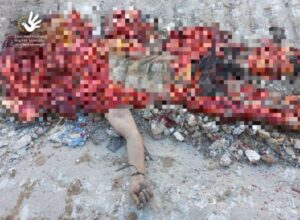
In keeping with those sorts of harsh Roman retributions, a leading European human rights organization has now documented that Israeli forces have begun killing Palestinians by driving over their living bodies with tanks and other military vehicles. Before being pixelated, the original image on the Internet was quite gruesome.
The Body of a Palestinian Prisoner, Crushed Flat While Alive by an Israeli Tank
I’d assume that many agitated Israelis still believe in the reality of the atrocity-hoax that Hamas beheaded 40 Israeli babies. So perhaps we will soon see the Israelis publicly beheading 400 Palestinian babies in retaliation for that imaginary crime.
Has Israel’s 5 month-long military operation in Gaza changed your thinking about the wisdom of creating a Jewish state?
Ron Unz—As is the case for most of us, while I was growing up I drew my knowledge of the world from the mainstream media and therefore always had a very positive view of Israel, admiring the great success it had achieved despite the bitter hostility of its Arab neighbors. As a young teenager, I remember celebrating Israel’s bold 1976 Entebbe commando-raid, which successfully freed the hostages held by a group of German and Palestinian terrorists, an incident later depicted in several Hollywood productions.
But for me, the turning point came in 1982, when Israel launched its totally unwarranted invasion of Lebanon. That operation killed many thousands of Lebanese civilians and culminated in the huge massacre at the Sabra and Shatilla refugee camps, in which hundreds or even thousands of Palestinian women and children were butchered, some of them in particularly grisly fashion. Israeli dissident academic Israel Shahak had correctly predicted those shocking events, but I’d dismissed him as a crackpot, so henceforth I took his views much more seriously.
Not long afterward, the New York Times and other leading media outlets revealed that as a young right-wing Zionist leader, Israel’s sitting prime minister had been a great admirer of Fascist Italy, and after World War II broke out, he’d repeatedly sought to enlist his Zionist faction in the Axis military alliance of Hitler and Mussolini. I also eventually discovered that during the 1930s, the mainstream Zionist movement led by David Ben-Gurion had formed a crucial economic partnership with Nazi Germany, which laid the basis for the creation of the State of Israel.
Although those remarkable facts were important, even more important was that such explosive revelations had been successfully concealed for more than forty years by our entire pro-Israel Western media. This convinced me that I couldn’t trust a single word the media said about Israel or the Middle East conflict.
Therefore, over the years and the decades that followed, I gradually sifted through this large mass of dishonest propaganda, seeking to extract a more accurate version of events. As I discussed in a long article late last year, the true circumstances of the creation of Israel in 1948 were really quite outrageous, as heavily armed Zionist settlers, most of them relatively recent arrivals, used a campaign of massacres and brutal atrocities to expel some 800,000 native Palestinians from the lands they’d inhabited for the previous couple of thousand years.
Although these days, the IDF is vastly better armed and can rely upon advanced American-supplied missiles and bombs to inflict most of its destruction, otherwise there doesn’t seem a huge difference between the events of three generations ago and those of today, with Zionist forces in both cases relying upon terror to drive out the inhabitants of the lands they seek to acquire. Indeed, nearly all of today’s Gazans are the descendants of Palestinians who had been violently expelled from their original homes during that earlier round of ethnic cleansing.
Whereas the recent story of Hamas militants roasting an Israeli baby in an oven was merely an atrocity-hoax, we have eyewitness testimony that back in 1948, the Zionist militants did indeed throw a young Palestinian boy into an oven and burn him alive, with his father soon following along behind him.
In 1948 during the Nakba, Zionist militias threw a Palestinian boy in the oven. Now Israelis are stealing this story and are trying to fabricate it against Hamas among the other now questionable events of Oct. 7th… pic.twitter.com/6fvq9txLQn
This raises an interesting point. Psychological projection is an important aspect of human behavior, with individuals often assuming that others think along the same lines as they themselves do. Over the last century or more, agitated Jewish activists have become notorious for falsely accusing their adversaries of committing the most extreme and grotesque atrocities, and I wonder if some of this might not represent their own dreams of the punishments they would wish to inflict upon their enemies if the tables were turned.
A particularly problematic aspect of Israel’s creation comes with regard to a different aspect of Jewish behavior. In a 2018 article I noted the tendency of Jews to cluster together and often work themselves into a dangerous frenzy:
As a rough analogy, a small quantity of uranium is relatively inert and harmless, and entirely so if distributed within low-density ore. But if a significant quantity of weapons-grade uranium is sufficiently compressed, then the neutrons released by fissioning atoms will quickly cause additional atoms to undergo fission, with the ultimate result of that critical chain-reaction being a nuclear explosion. In similar fashion, even a highly agitated Jew may have no negative impact, but if the collection of such agitated Jews becomes too numerous and clusters together too closely, they may work each other into a terrible frenzy, perhaps with disastrous consequences both for themselves and for their larger society. This is especially true if those agitated Jews begin to dominate certain key nodes of top-level control, such as the central political or media organs of a society.
Israel’s Jews obviously constitute the fullest example of such clustering, so perhaps we should not be too surprised at their extremely frenzied ideological chain-reaction of the last five months. Unfortunately, this has resulted in their exceptionally bloody rampage in Gaza, which also seems to be fully endorsed by many or most American Jews, especially the most prominent and influential ones.
A week ago, US President Joe Biden pledged to organize air-drops of aid into northern Gaza. But there is already enough food to feed the entire population stuck in trucks right outside the Rafah crossing. Why doesn’t Biden simply insist that Israel allow that food to be delivered ASAP? Is this just a publicity stunt or is Biden sincere in wanting to feed starving Palestinians?
Ron Unz—I think this strange situation represents the utter and total humiliation of America, despite its boastful claims of being the world’s sole superpower.
We have demonstrated to the entire world that our country has now become nothing more than a political colony of Israel, run by a puppet government under the complete control of the pro-Israel Lobby and its financial donors.
Many have pointed out that although Israeli President Benjamin Netanyahu is a very weak and besieged figure in his own country, he and his allies certainly exercise greater control over the U.S. Congress, including both Democrats and Republicans, than does President Joe Biden or any Republican leader.
In the British Empire of the late nineteenth century, India had a population many times larger than that of Britain itself, but the subcontinent was entirely under British control. India’s leaders had no say over their own foreign policy, which instead was determined by a few individuals on the other side of the world. I think that America’s relationship to Israel is rapidly approaching that same situation.
President Biden faces a very difficult reelection challenge, with a large portion of his own Democratic voter base outraged over the scenes of devastation and starvation among Gaza’s Palestinians that they are seeing every day on their social media. So he would obviously like to mitigate his political problems by ensuring that food is delivered to Gaza’s starving Palestinians.
However, the Israelis have refused to allow the entry of sufficient trucks carrying food, and since the Israeli government controls the American government rather than the other way round, there’s not much that our President can do against that Israeli refusal. Therefore, Biden has resorted to desperate publicity stunts, such as air-dropping a few pallets of food, hoping that such transparent ploys will deceive his angry voters.
Meanwhile, the Israelis have been gleefully distributing a video on Telegram showing a starving dog in Gaza eating the body of a dead Palestinian child.
The “genocide” moniker has been affixed to Israel like a scarlet letter. Do you think Israel’s leaders really grasp the long-term implications of this designation?
Ron Unz—I think that the Israeli leaders have become so arrogant, so insular, and so confident in their complete political control over the enormous power of the U.S. and its media that they don’t have the slightest concern over what the people of the world think. This explains their very public massacre of Gaza’s helpless civilians by bombs, bullets, and starvation.
After all, the Israelis and their Zionist predecessors have been freely committing the worst sort of crimes and atrocities for generations, without ever incurring any penalty. Instead, nearly all of those dark deeds were either successfully concealed by their media allies or have been almost entirely forgotten. As I wrote in early 2020:
Indeed, the inclination of the more right-wing Zionist factions toward assassination, terrorism, and other forms of essentially criminal behavior was really quite remarkable. For example, in 1943 Shamir had arranged the assassination of his factional rival, a year after the two men had escaped together from imprisonment for a bank robbery in which bystanders had been killed, and he claimed he had acted to avert the planned assassination of David Ben-Gurion, the top Zionist leader and Israel’s future founding-premier. Shamir and his faction certainly continued this sort of behavior into the 1940s, successfully assassinating Lord Moyne, the British Minister for the Middle East, and Count Folke Bernadotte, the UN Peace Negotiator, though they failed in their other attempts to kill American President Harry Truman and British Foreign Minister Ernest Bevin, and their plans to assassinate Winston Churchill apparently never moved past the discussion stage. His group also pioneered the use of terrorist car-bombs and other explosive attacks against innocent civilian targets, all long before any Arabs or Muslims had ever thought of using similar tactics; and Begin’s larger and more “moderate” Zionist faction did much the same.
As far as I know, the early Zionists had a record of political terrorism almost unmatched in world history, and in 1974 Prime Minister Menachem Begin once even boasted to a television interviewer of having been the founding father of terrorism across the world.
One of history’s largest terrorist attacks prior to 9/11 was the 1946 bombing of the King David Hotel in Jerusalem by Zionist militants dressed as Arabs, which killed 91 people and largely destroyed the structure. In the famous Lavon Affair of 1954, Israeli agents launched a wave of terrorist attacks against Western targets in Egypt, intending to have those blamed on anti-Western Arab groups. There are strong claims that in 1950 Israeli Mossad agents began a series of false-flag terrorist bombings against Jewish targets in Baghdad, successfully using those violent methods to help persuade Iraq’s thousand-year-old Jewish community to emigrate to the Jewish state…
The enormous extent of pro-Israel influence in world political and media circles meant that none of these brutal attacks ever drew serious retaliation, and in nearly all cases, they were quickly thrown down the memory hole, so that today probably no more than one in a hundred Americans is even aware of them. Furthermore, most of these incidents came to light due to chance circumstances, so we may easily suspect that many other attacks of a similar nature have never become part of the historical record.
When countries develop a sense of total impunity, their actions may steadily escalate. Because Israel and its government were never called to account or punished for any of their crimes, their transgressions steadily became bolder and more daring as the decades went by.
For example, as part of his non-proliferation efforts, President John F. Kennedy was determined to prevent Israel from acquiring nuclear weapons, making that project one of his top foreign policy initiatives. He exerted enormous pressure towards that goal, threatening Israel with a cut-off of all American financial support and initiating the legal destruction of its political lobby, the predecessor of AIPAC. All those American policies were immediately reversed after Kennedy’s 1963 assassination, and in that same 2020 article I outlined the strong, perhaps even overwhelming evidence that Israel’s Mossad played a central role in the death of our President, one of the most famous events of the twentieth century, as well as in the subsequent assassination of his brother Sen. Robert F. Kennedy when the latter ran for President a few years later.
During 1967, Israel launched a deliberate air and sea attack against the U.S.S. Liberty intended to leave no survivors, killing or wounding over 200 American servicemen before word of the attack reached our Sixth Fleet and the Israelis withdrew. That incident was the deadliest assault on an American naval vessel since World War II and if any other nation had been responsible, our country would certainly have declared war. Instead, the American government and media have entirely concealed the history of that event for the last half-century so that even today few Americans are aware that it ever happened.
Then in 2001, Israel faced a desperate crisis as the widespread suicide bombings of the Second Palestinian Intifada threatened its survival, with numerous hostile Arab nations supporting that campaign. But the sudden 9/11 Attacks on America totally changed the strategic situation, allowing the fiercely pro-Israel Neocons to immediately gain control of the stunned George W. Bush administration. Under their influence, the War on Terror became the centerpiece of American foreign policy, and over the next dozen years the world’s sole superpower destroyed most of Israel’s leading regional adversaries including Iraq, Libya, and Syria, while nearly attacking Iran on several occasions. Last year I recapitulated the strong, even overwhelming evidence that Israel’s Mossad had been responsible for the 9/11 Attacks that successfully reversed Israel’s very difficult predicament.
Given three generations of such total Israeli impunity, it’s easy to understand why Israel’s leaders today seem so nonchalant about the charges of genocide their country faces. South Africa provided a 91 page legal brief documenting its accusations to the International Court of Justice, and those jurists affirmed those charges in a series of near-unanimous rulings. Most observers naturally expected that such formidable legal developments would force the Israelis to back away from their Gaza attacks, but the latter instead demonstrated their total contempt for that international body by redoubling their efforts, continuing their bombing while further reducing the food and water available to Gaza’s starving population of two million.
However, it is possible that the government of Israel might be making a serious miscalculation. Their past crimes had been successfully suppressed by the pro-Israel gatekeepers of the mainstream media, preventing nearly all people around the world from ever becoming aware of them. But in recent years our informational landscape has been drastically transformed by the rise of the Internet, social media, and numerous video platforms. These have allowed the horrific unfiltered images of Gaza’s devastation to be seen worldwide, including by a large portion of our electorate, especially the younger Americans who heavily rely upon those new channels of information. The result has been a wave of huge, spontaneous protests across many Western countries and at many American universities.
61 percent of the houses of the people of Gaza were destroyed to such a degree after 60 days of continuous encroachment by the Zionist regime. ــــ
By breaking the media stranglehold long enjoyed by Israel’s partisans, these technological changes may have important political consequences. Surprisingly large numbers of Democratic voters in Michigan and Minnesota have refused to support President Joe Biden on their primary ballots, raising fears that his November reelection prospects against former President Donald Trump might be slipping away. And in a British by-election, George Galloway, a fierce supporter of Gaza and critic of Israel, won more votes than the combined total of all the candidates from Britain’s major parties, suggesting that concerns over Gaza were becoming an important political issue in that country as well.
Aaron Bushnell’s picture is now circulating on social media sites around the world. The majority of people appear to have very moved by his extraordinary act of self-sacrifice. In your opinion, has Bushnell’s self-immolation helped to change the way people think about what’s going on in Gaza?
Ron Unz—I think that the consequences may be enormous. I’ve heard the American mainstream media quickly “disappeared” the story after a day or two, so that it had little influence upon the older Americans who rely upon those legacy outlets. But everywhere else—across social media and non-Western broadcasters—the impact must have been gigantic.
Let’s put the shoe on the other foot. Suppose a Russian military serviceman had burned himself alive outside the Kremlin as an act of personal protest against his country’s Ukraine war. Surely the Western media would have treated that event as the biggest story in the world for days, even weeks, declaring that it proved President Vladimir Putin had lost the support of his own people, and his crumbling regime was headed for collapse. The leadership and people of Russia, China, Iran, and all the other countries that are not totally under American media control must view this incident in much the same way.
As far as I know, nothing similar has ever previously occurred in American history, and only very rarely in other countries around the world. A South Vietnamese Buddhist monk set himself on fire in 1963 to protest his government’s policies and a few months later the ruling regime he opposed was overthrown. In 2010 a Tunisian food-vendor immolated himself and his death launched the Arab Spring, bringing down governments all across North Africa and the Middle East. Although America’s dominance over the global media provides a considerable measure of protection against such popular forces, I think our regime may have suffered a major body-blow.
How many young men like Aaron Bushnell has the US government burned in wars for Israel? How many have they quietly allowed to commit suicide because of what they were forced to participate in? Let no more Americans be sacrificed to the alter of Zionism.
Media rules our world, being vastly more powerful than tank battalions or nuclear weapons since it acts as a force of mind-control, shaping the thoughts and beliefs of the individuals who deploy those physical weapons. I wouldn’t be surprised if the dollar-value of the global media coverage of Bushnell’s personal sacrifice totaled in the billions. That’s hardly an insignificant sacrificial accomplishment for an unknown 25-year-old lacking any special skills. In fact, it’s difficult to imagine anything else he could have done that had as high a chance of success and greater positive impact.
Bushnell had been raised in an isolated Christian community, aware from his childhood that the founding figure of his own religion had died a horrible death on the Cross in order to redeem mankind. So self-sacrifice and martyrdom had always been a central element of his faith.
Furthermore, any individual who enlists in the military must recognize that he might someday be called upon to make the supreme sacrifice for his own country, and Bushnell was hardly alone in regarding our ruling regime as an illegitimate one, whose policies were completely antithetical to the values of the country he’d sworn to defend. So in some respects, his fate was not so very different from that of any patriotic American military serviceman who died in the flaming wreckage of his destroyed plane or tank.
For years it’s been quite apparent to me that America’s national government had lost almost all of its political legitimacy, being something much closer to the decaying hulk of the late, unlamented USSR than to the republic we once knew. Bushnell’s personal sacrifice provided a signpost to that bitter reality and may also have brought us a step closer to the collapse of that regime.
For similar reasons, I think that the tens of thousands of dead Gazans did not lose their lives in vain. Instead, their martyrdom has dominated the global media for the last five months, conclusively revealing to the entire world the moral bankruptcy of the international system that had condemned them to their fate.
Probably hundreds of millions of people worldwide have now begun asking themselves questions that they never would have previously considered. I suspect that those responsible for the destruction of Gaza may come to rue the day when they helped open doors that they may eventually wish had been kept tightly shut.
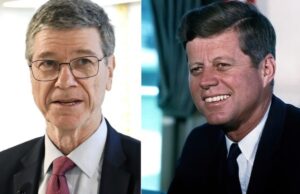
Although the November 22, 1963 assassination of President John F. Kennedy was surely one of the most famous events of the twentieth century, its sixtieth anniversary passed a few months ago with relatively little attention, probably overshadowed by the looming defeat of Ukraine in its war with Russia and also the enormous civilian casualties following the sudden outbreak of the Israel/Gaza conflict. But many individuals of an older generation probably remembered that tragic date, and I think that one of them may have been Prof. Jeffrey Sachs of Columbia University.
Born in 1954, Sachs had just turned nine years old a couple of weeks before the events in Dallas threw our entire nation into mourning. In recent months he has frequently emphasized his great admiration for our slain leader, whose speeches and public statements seemed to offer hope for world peace, a possibility soon tragically lost.
I suspect that much like myself, over the decades Sachs had always dismissed and ignored the conspiratorial theories of the JFK assassination that were so popular during the 1960s and 1970s then gradually faded away during the more optimistic 1980s. But my eventual discovery of various other major historical anomalies finally led me to begin exploring the facts of the JFK assassination a dozen years ago. Perhaps a very similar process over the last couple of years has now led Sachs’ thinking to move in the same direction, propelled by his shock at discovering official cover-ups on entirely different issues.
Until just a few months ago, I doubt there were many American academics more solidly situated in the topmost ranks of our elite mainstream establishment than Prof. Jeffrey Sachs of Columbia University.
In 1983 he gained Harvard University tenure at the remarkably young age of 28, then spent the next 19 years as a professor at that august academic institution; by the early 1990s the New York Timeswas already hailing him as the world’s most important figure in his field. Lured to Columbia University in 2002, he has spent the last couple of decades teaching there and also directing a couple of its research organizations, most recently the Center for Sustainable Development. TIME Magazine has twice ranked him among the world’s 100 most influential individuals, and for nearly twenty years he served as Special Advisor to several Secretary-Generals of the United Nations, while publishing many hundreds of articles and op-eds on a wide variety of subjects in our most influential media outlets.
It would be difficult to construct a more illustrious and establishmentarian curriculum vitae for an international academic figure, so in 2020 he was a natural choice to serve as chairman of the Lancet‘s Covid Commission, established to investigate all aspects of the deadly worldwide pandemic.
Yet as he has subsequently explained in his interviews, over the course of the last couple of years he became increasingly suspicious that the true origins of the viral disease were being concealed. More than eighteen million people have died worldwide including over a million Americans, and rather than acquiescing in what he came to believe was an ongoing official cover-up, he broke with the establishment and made the courageous decision to bring the true facts to widespread public attention.
Although he has retained the subdued manner and careful phraseology of a mild academic, in recent months the incendiary content of his published articles and his public statements have exploded across the global landscape, reaching many millions who might otherwise never have questioned what they were so uniformly being told by all our mainstream media organs. His critics defending that orthodoxy must surely believe that he has gone dangerously rogue, and given the enormous weight of his past credibility, I suspect that the phrase “rogue elephant” has sometimes entered their thoughts.
From the earliest days of the Covid epidemic, an official narrative was promoted that the virus was natural and editors of the leading scientific journals closed their pages to any submissions that suggested otherwise. With no reputable academic papers challenging their perspective, the natural origins advocates were able to cite this silence as proof that their position represented the overwhelming scientific consensus, thereby intimidating most mainstream journalists into toeing that same line. A massive propaganda-bubble had been inflated and maintained by such administrative means.
However, as a member of the National Academy of Sciences, Prof. Sachs had publication privileges in the prestigious PNAS journal, so in May he and a co-author published an important article documenting the highly suspicious characteristics of the Covid virus and calling for further investigation. This constituted a breakthrough, becoming the first and only paper published in a major journal that presented the very strong evidence of Covid bioengineering.
Given his role as chairman of the Covid Commission, Sachs’ paper should have been treated as a bombshell, reaching the headlines of all our leading newspapers. But instead, it was almost totally ignored, as was the author’s public statements on the subject. However, the following month, Sachs attended a small Spanish thinktank gathering, whose proceedings were soon made available on Youtube. Russia’s RT eventually ran a brief item highlighting Sachs’ presentation, and a short clip of his remarks soon went super-viral, retweeted out almost 11,000 times and accumulating over a million views.
Having publicly broken ranks with the political establishment over Covid, he soon began doing the same on other important issues. During July and August he published a couple of opinion columns condemning our reckless policies towards Russia and China, with the former having already provoked a bloody and dangerous war in Ukraine and the latter periodically threatening to do the same over Taiwan.
A few months later, a series of massive underwater explosions severely damaged the $30 billion Russian-German Nord Stream pipelines. This constituted the greatest act of industrial terrorism in the history of the world, with potentially crippling long-term impact upon the energy supplies of Germany and other European countries. Although there was enormous circumstantial evidence implicating America in those attacks, and renowned investigative journalist Seymour Hersh later revealed the exact details of the sabotage operation, the entire Western media and political establishment stubbornly pretended to see nothing, instead absurdly accusing Russia of having destroyed its own energy pipelines.
But Sachs refused to support this cover-up and he instead played an important role in breaking the media blockade:
Then a few days later, Bloomberg TV invited Sachs to share his concerns over the Ukraine war. His hosts were flabbergasted when he flatly declared that America had probably destroyed the Russian pipelines, even mentioning that top journalists had privately told him the same thing, although none of those vital facts could ever appear in their own newspapers.
As a consequence of Sachs’ candor, the interview was cut short—with Sachs “yanked off air” in the words of the hostile New York Post—but the entire segment was watched at least a couple of hundred thousand times on Youtube and the short clip of Sachs’ Nord Stream remarks soon went super-viral on Twitter, viewed more than 4 million times in one Tweet and another million times across a couple of others.
It has been extremely rare for a public figure of such high establishmentarian credentials to directly challenge such important narratives, and Sachs’ remarkable candor soon made him a very popular guest on numerous podcasts and channels.
A couple of years earlier he had also discovered that many of his long held assumptions about the Middle East conflict had been mistaken, as I discussed late last year.
Different scholars have different fields of expertise, and Sachs is an international economist, whose regions of focus have been the former Soviet Bloc countries, Latin America, and China, but apparently without much emphasis upon the Middle East. However, during the long Covid lock-downs, he expanded his knowledge of the Israeli-Palestinian conflict by reading a recently published book by Prof. Rashid Khalidi, one of his Columbia University colleagues, then joined the author for a very interesting hour-long discussion available on Youtube.
By purest chance, I stumbled across that video several months ago, not long before the region suddenly erupted in unexpected violence, and found it an excellent presentation of the important historical facts, many of them previously unknown to me, while Sachs similarly emphasized that he was forced to “unlearn” much of the history that he had casually absorbed over the years.
Perhaps partly as a consequence, he has been extremely forthright in denouncing the ongoing slaughter and starvation of Gaza’s helpless civilian population, and the remarkable unwillingness of the Biden Administration to force Israel to end its military rampage. As he recently put it, on these matters Israeli Prime Minister Benjamin Netanyahu sometimes seems to act as if he were our actual president instead of the confused individual sitting in the Oval Office.
Preoccupied with our own affairs, most of us live our lives within the safe cocoon of our media-generated framework of reality and rarely question the historical narratives that we have absorbed from our earliest youth. But once we discover that the government and its media allies have been promoting utter falsehoods on matters of great importance and shamelessly maintaining those falsehoods despite enormous evidence to the contrary, we naturally begin to question more and more additional issues. The longstanding controversy surrounding JFK’s assassination may become one of these.
Over the last year, Sachs has become a regular weekly interview guest on Judge Andrew Napolitano’s video podcast, and one of his leading concerns has been our country’s disastrously aggressive foreign policy following the end of the Cold War. He has frequently complained that America no longer does diplomacy, but merely overthrows governments around the world that refuse to follow its dictates, noting that academic scholars have compiled lists containing many dozens of such successful or attempted CIA coups. Our government’s 2014 overthrow of Ukraine’s neutralist and democratically-elected government was one of the most important of these since it ultimately led to the outbreak of the war with Russia in 2022, a conflict that has cost many hundreds of thousands of lives and now threatens to draw in NATO forces, taking us to the brink of World War III.
Very sharp criticism of the CIA has become a staple of Napolitano’s daily guests, several of whom are themselves former members of that organization. Ray McGovern spent 27 years as a CIA analyst, rising to become head of its Soviet analysis group and serving for years as the president’s morning intelligence briefer, obviously positions of considerable responsibility. But he has been especially scathing towards the operational side of the CIA, which he believes has metastasized into a private army, routinely involved in coups and assassinations and accountable only to the president and sometimes only to itself.
These are widely acknowledged facts, and it requires only a slight logical step to connect them to the events of 1963. All our mainstream history books emphasize that President Kennedy had become intensely critical of the CIA’s activities in the wake of the disastrous failure of its Bay of Pigs invasion of Cuba, removing several of its top leaders and allegedly vowing to “splinter the CIA into a thousand pieces and scatter them to the wind.” Under such circumstances, it hardly seems implausible that intelligence operatives who were regularly involved in killings and regime-change operations might have decided to employ those same skills domestically if they believed that their own vital interests were severely threatened. For well over half a century, there has been very widespread speculation that CIA members were directly involved in the JFK assassination.
Although this logical step may seem a very small one, prominent and respectable public figures have been extremely reluctant to take it, and our mainstream media has for decades completely stigmatized or ignored any such “conspiracy theories.” As a consequence of that total lack of reputable supporters, I had always casually dismissed the possibility.
But much as he had done in the case of Covid’s origins and the Nord Stream pipeline attacks, Prof. Jeffrey Sachs has now taken that bold step, possibly blowing a hole in a sixty-year cover-up. In his Thursday interview, already viewed nearly 140,000 times, he mentioned that there seemed to be very strong evidence that elements of the CIA had been involved in the JFK assassination, which he suggested might have been “the most decisive event in modern American history.” He even speculated that in the aftermath of that presidential killing, most or all of Kennedy’s successors in the Oval Office may have become little more than “factotums of the system,” lacking the power to fully implement independent policies.
These brief remarks would hardly have provoked surprise within conspiratorial circles or among those who have spent years or decades investigating the JFK assassination. But I think Sachs has become the highest-ranking mainstream figure to ever publicly voice such ideas and this may prompt others to follow his lead.
Over the last year or two, the questions surrounding the assassination of JFK had already returned to public discussion. Although the circumstances were quite different, an earlier break in the dam had occurred in late 2022, as I noted in an article at that time:
Tucker Carlson hosts the most popular cable news show and last Thursday he aired an explosive segment in which he declared that that 1963 assassination of President John F. Kennedy had been the work of a conspiracy, with our own CIA heavily involved.
Carlson’s regular nightly audience is over 3 million, and more than a million have already watched the Youtube video, so these bombshell accusations regarding the events in Dallas have probably now reached more ordinary Americans than anything else on the topic in the three decades since Oliver Stone’s Oscar-winning film JFKwas playing in the theaters.
Robert F. Kennedy, Jr., nephew of the slain President and son of his murdered brother praised Carlson’s show as “the most courageous newscast in 60 years,” and his remarks have been Retweeted more than 22,000 times.
In recent decades, such conspiratorial beliefs on the JFK assassination have been largely confined to the Left, with Stone himself being a prime example. But Carlson is one of America’s most influential conservatives, so he may have successfully implanted these ideas among a portion of our citizenry previously unexposed to them. He also noted that widespread use of the insulting phrase “conspiracy theory” only began in the aftermath of the JFK assassination, with the CIA itself successfully marginalizing its critics by promoting that accusation in the compliant media.
Although Carlson hardly had Sachs’ academic reputation or international credibility, his discussion of the issue and Kennedy’s strong praise may have led Sachs and many others to begin questioning the official story. Every crack in the wall may lead to the next one.
Most individuals are very reluctant to acknowledge that they have been entirely mistaken about such an important matter for nearly their entire lives, or at least that was true in my own case. As I explained a few years ago:
Having read a couple of books that completely upended my settled beliefs about a central event of twentieth century history, I simply didn’t know what to think. Over the years, my own writings had put me on friendly terms with a well-connected individual whom I considered a member of the elite establishment, and whose intelligence and judgment had always seemed extremely solid. So I decided to very gingerly raise the subject with him, and see whether he had ever doubted the “lone gunman” orthodoxy. To my total astonishment, he explained that as far back as the early 1990s, he’d become absolutely convinced in the reality of a “JFK conspiracy” and over the years had quietly devoured a huge number of the books in that field, but had never breathed a word in public lest his credibility be ruined and his political effectiveness destroyed.
A second friend, a veteran journalist known for his remarkably courageous stands on certain controversial topics, provided almost exactly the same response to my inquiry. For decades, he’d been nearly 100% sure that JFK had died in a conspiracy, but once again had never written a word on the topic for fear that his influence would immediately collapse.
Few other revelations in recent years have so totally overturned my understanding of the framework of reality. Even a year or two later, I still found it very difficult to wrap my head around the concept, as I described in another note to that same well-connected friend of mine:
BTW, I hate to keep harping on it, but every time I consider the implications of the JFK matter I’m just more and more astonished.
The president of the US. The heir to one of the wealthiest and most powerful families in America. His brother the top law enforcement officer in the country. Ben Bradlee, one of his closest friends, the fearless crusading editor of one of the nation’s most influential media outlets. As America’s first Catholic president, the sacred icon of many millions of Irish, Italian, and Hispanic families. Greatly beloved by top Hollywood people and many leading intellectuals.
His assassination ranks as one of the most shocking and dramatic events of the 20th century, inspiring hundreds of books and tens of thousands of news stories and articles, examining every conceivable detail. The argument from MSM silence always seemed absolutely conclusive to me.
From childhood, it’s always been obvious to me that the MSM is completely dishonest about certain things and over the last dozen years I’ve become extremely suspicious about a whole range of other issues. But if you’d asked me a couple of years ago whether JFK was killed by a conspiracy, I would have said “well, anything’s possible, but I’m 99% sure there’s absolutely no substantial evidence pointing in that direction since the MSM would surely have headlined it a million times over.”
I have no idea where Sachs currently stands in his exploration of the issues that he briefly raised last week, and perhaps he has already investigated the subject in much greater depth than his words suggested. But if not, I think I can provide some useful guideposts both to him and to any others who have now decided to seriously explore the JFK assassination for the first time. I am a rank amateur myself, who not so many years ago was exactly in that same situation, so my own suggestions might be much more helpful than those of someone who had spent decades studying the complex details of the topic.
If a newcomer decided to read only a single book on the JFK assassination conspiracy, my first recommendation would be Brothers: The Hidden History of the Kennedy Years, published in 2007 by David Talbot, the founder of Salon and a well-regarded if liberal-leaning journalist. I discussed some of his important material in my 2018 article:
The Talbot book especially impressed me, being based on over 150 personal interviews and released by The Free Press, a highly reputable publisher. Although he applied a considerable hagiographic gloss to the Kennedys, his narrative was compellingly written, with numerous gripping scenes. But while such packaging surely helped to explain some of the favorable treatment from reviewers and how he had managed to produce a national bestseller in a seemingly long-depleted field, for me the packaging was much less important than the product itself.
To the extent that notions of a JFK conspiracy had ever crossed my mind, I’d considered the argument from silence absolutely conclusive. Surely if there had been the slightest doubt of the “lone gunman” conclusion endorsed by the Warren Commission, Attorney-General Robert Kennedy would have launched a full investigation to avenge his slain brother.
But as Talbot so effectively demonstrates, the reality of the political situation was entirely different. Robert Kennedy may have begun that fatal morning widely regarded as the second most powerful man in the country, but the moment his brother was dead and his bitter personal enemy Lyndon Johnson sworn in as the new president, his governmental authority almost immediately ebbed away. Longtime FBI Director J. Edgar Hoover, who had been his hostile subordinate, probably scheduled for removal in JFK’s second term, immediately became contemptuous and unresponsive to his requests. Having lost all his control over the levers of power, Robert Kennedy lacked any ability to conduct a serious investigation.
According to numerous personal interviews, he had almost immediately concluded that his brother had been struck down at the hands of an organized group, very likely including elements from within the U.S. government itself, but he could do nothing about the situation. As he regularly confided to close associates, his hope at the age of 38 was to reach the White House himself at some future date, and with the government in his hands then uncover his brother’s killers and bring them to justice. But until that day, he could do nothing, and any unsubstantiated accusations he made would be totally disastrous both for national unity and for his own personal credibility. So for years, he was forced to nod his head and publicly acquiesce to the official story of his brother’s inexplicable assassination at the hands of a lone nut, a fairy tale publicly endorsed by nearly the entire political establishment, and this situation deeply gnawed at him. Moreover, his own apparent acceptance of that story was often interpreted by others, not least in the media, as his wholehearted endorsement.
Although discovering Robert Kennedy’s true beliefs was a crucial revelation in the Talbot book, there were many others. At most three shots had allegedly come from Oswald’s rifle, but Roy Kellerman, the Secret Service agent in the passenger seat of JFK’s limousine, was sure there had been more than that, and to the end of his life always believed there had been additional shooters. Gov. Connolly, seated in front of JFK and severely wounded in the attack, had exactly the same opinion. CIA Director John McCone was equally convinced that there had been multiple gunmen. Across the pages of Talbot’s book, I learned that dozens of prominent, well-connected individuals privately expressed extreme skepticism towards the official “lone gunman theory” of the Warren Commission, although such doubts were very rarely made in public or on the record.
For a variety of complex reasons, the leading national media organs—the commanding heights of “Our American Pravda”—almost immediately endorsed the “lone gunman theory” and with some exceptions generally maintained that stance throughout the next half-century. With few prominent critics willing to publicly dispute that idea and a strong media tendency to ignore or minimize those exceptions, casual observers such as myself had generally received a severely distorted view of the situation.
If the first two dozen pages of the Talbot book completely overturned my understanding of the JFK assassination, I found the closing section almost equally shocking. With the Vietnam War as a political millstone about his neck, President Johnson decided not to seek reelection in 1968, opening the door to a last minute entry into the Democratic race by Robert Kennedy, who overcame considerable odds to win some important primaries. Then on June 4, 1968, he carried gigantic winner-take-all California, placing him on an easy path to the nomination and the presidency itself, at which point he would finally be in a position to fully investigate his brother’s assassination. But minutes after his victory speech, he was shot and fatally wounded, allegedly by another lone gunman, this time a disoriented Palestinian immigrant named Sirhan Sirhan, supposedly outraged over Kennedy’s pro-Israel public positions, although these were no different than those expressed by most other political candidates in America.
All this was well known to me. However, I had not known that powder burns later proved that the fatal bullet had been fired directly behind Kennedy’s head from a distance of three inches or less although Sirhan was standing several feet in front of him. Furthermore, eyewitness testimony and acoustic evidence indicated that at least twelve bullets were fired although Sirhan’s revolver could hold only eight, and a combination of these factors led longtime LA Coroner Dr. Thomas Naguchi, who conducted the autopsy, to claim in his 1983 memoir that there was likely a second gunman. Meanwhile, eyewitnesses also reported seeing a security guard with his gun drawn standing immediately behind Kennedy during the attack, and that individual happened to have a deep political hatred of the Kennedys. The police investigators seemed uninterested in these highly suspicious elements, none of which came to light during the trial. With two Kennedy brothers now dead, neither any surviving members of the family nor most of their allies and retainers had any desire to investigate the details of this latest assassination, and in a number of cases they soon moved overseas, abandoning the country entirely. JFK’s widow Jackie confided in friends that she was terrified for the lives of her children, and quickly married Aristotle Onassis, a Greek billionaire, whom she felt would be able to protect them.
Taken as a whole, I found Talbot’s narrative quite convincing, at least with respect to demonstrating the existence of a substantial conspiracy behind the fatal event.
Others certainly had the same reaction, with the influential pages of The New York TimesSunday Book Review carrying the strongly favorable reaction of presidential historian Alan Brinkley. As the Allan Nevins Professor of History and Provost of Columbia University, Brinkley is as mainstream and respectable an academic scholar as might be imagined and he characterized Talbot as
the latest of many intelligent critics who have set out to demolish the tottering credibility of the Warren Commission and draw attention to evidence of a broad and terrible conspiracy that lay behind the assassination of John Kennedy — and perhaps the murder of Robert Kennedy as well.
For those less interested in reading an entire book, I think my pair of 2018 articles serves as a useful introduction to the subject, presenting the overview of a newcomer while suggesting more than a dozen books that would provide far more detailed analysis of the issue and its particular elements.
I also believe that it’s quite important to divide all discussions of the JFK assassination into two separate categories. The first involves efforts to determine whether the official story is correct or instead that the assassination had been the result of the conspiracy. And if that latter conclusion is established, we must then seek to determine the likely identities of those conspirators. Most books and articles fall primarily into one category or the other, but obviously establishing the existence of a conspiracy is that first and most important step that must be taken, and with few exceptions our mainstream journalists and academics have stubbornly refused to publicly admit that reality.
If my articles might provide a brief introduction to the topic and the Talbot book a good and solid serious beginning, I’d also like to recommend a book at the opposite end of the spectrum, far more complex and especially important to those focused on the possible role of the CIA. The author exhaustively analyzed a large collection of declassified but heavily redacted CIA documents, not only confirming that involvement and working out a central element of the plot but even identifying the key CIA conspirator.
By purest chance, Carlson’s show had aired just a few days after I had finished reading an important book on the JFK assassination that someone had brought to my attention last year. Originally published almost thirty years ago, this work provided some crucial insights into how the political cover-up of the conspiracy had been arranged, a cover-up that has now endured for nearly six decades. The most powerful man in the world had been killed at the very height of America’s postwar success and prosperity, yet nearly all of America’s political elites were successfully enlisted to suppress the truth of what had happened.
John Newman had spent twenty years in Military Intelligence and afterward became a professor of history at the University of Maryland. Since then, he had applied the technical skills that he had honed in his many years of government service to analyzing the bureaucratic minutia of declassified government files and using this material to produce a series of books on the hidden side of American government policies during the 1960s, including our growing involvement in Vietnam and especially the complex circumstances of the JFK assassination. Oswald and the CIA originally appeared in 1993, but the 2008 edition included a new epilogue, summarizing some of his most important findings.
The book is a lengthy one, running over 650 pages with notes and appendices, and his exhaustively detailed analysis of the released intelligence files and their interpretation can be eye-glazingly dull at points, but his broader conclusions are not difficult to state. The profusion of internal CIA documents regarding Oswald and his movements seems completely inconsistent with any institutional plot at the Agency to kill Kennedy, but might fit very well with the hypothesis of a “rogue faction” at the CIA having played a central role in the affair.
Newman argued that Oswald was exactly the “patsy” that he claimed to be, but more importantly he drew a very sharp distinction between the small group of plotters who had actually organized the JFK assassination itself and the much larger group who carried out the subsequent cover-up, with the motives of many of those latter individuals being entirely different. As he persuasively explained in his epilogue, the conspirators had created a false intelligence trail suggesting that Oswald might have been a Soviet agent, and then used that misinformation to force our fearful government leadership into become their unwitting accomplices after the fact, compelling them to suppress all evidence of any conspiracy in Dallas.
Newman’s crucial conclusions are worth quoting at length:
It is now clear that most of the U.S. leaders and officials who participated in the national security cover-up had nothing to do with the plot that was hatched before the president’s murder. Many of them—including leading legislators and Supreme Court Chief Justice Earl Warren—were motivated by the perceived threat of a nuclear exchange with the Soviet Union. Inside the executive branch of government, many others were motivated by the desire to protect their jobs and their institutions. Their collective actions, however, were not the result of an accident; rather, they were the forced checkmate in the endgame of an ingenious plan.
The plan was designed to force official Washington to bury a radioactive story in Oswald’s files in order for America to survive. The plan worked. No matter how sloppy the performance of the shooters in Dallas was, no matter how bungled the autopsy and the handling of the evidence was, all would be trumped by the threat of WWIII and 40 million dead Americans. From the beginning, the plot was based upon the assumption that, when presented with this horrific possibility, everyone would fall into line. This assumption was correct.
…There was a darker purpose for Oswald’s visit to Mexico City. He was sent there to seek visas from the Cuban Consulate and Soviet Embassy…the objective was simply incidental contact between Oswald and the man who issued Soviet visas in Mexico City: Valery Kostikov. The value of this contact derived from what only a handful of counterintelligence officers in Washington knew: Kostikov was an important operative of the KGB assassinations in the Americas…The handler’s purpose in having both Oswald’s and Kostikov’s names mentioned was to place evidence into the CIA’s records that, on 22 November, would link KGB assassinations to the murder of President Kennedy. The activities of this impersonator are what made it possible for President Johnson to tell Senator Russell on 29 November that those investigating the case were “testifying that Khrushchev and Castro did this.” Johnson insisted that this must be prevented “from kicking us into a war that can kill forty million Americans in an hour.”
I went on to say:
So under Newman’s convincing reconstruction, most of the powerful American officials who played such a pivotal role in concealing the conspiracy may have been acting under the best of intentions, seeking to protect our country from the risk of a devastating retaliatory war with the Soviets. And obviously these concerns would have been deliberately fanned by those among them who had been involved in the plot and created the false trail of evidence connecting Oswald with KGB assassination efforts.
The author therefore argued that creating that false trail had constituted an absolutely crucial element of the assassination plot, and by a very careful examination of the intelligence files, he concluded that longtime CIA Counter-Intelligence Chief James Angleton had been the likely culprit, thus identifying him as one of the key conspirators. This conclusion meshes perfectly with the entirely different arguments advanced by the late Michael Collins Piper in Final Judgment, his 1994 landmark work, which had also argued that Angleton was a central figure in the assassination.
Although Sachs’ statements last week certainly reflected his true beliefs regarding the likely role of the CIA in the JFK assassination, I think his willingness to publicly express them was mostly due to his deep concerns over our country’s extremely reckless international behavior and the huge danger it posed to global peace. For the past two years, America and its NATO allies have been fighting a proxy war against nuclear-armed Russia on Russia’s own border. Such a project would have been considered unthinkable madness during the height of the old Cold War, but that policy has now become an almost universal bipartisan consensus among the West’s political and media elites.
As Sachs has correctly emphasized, the relentlessly aggressive Neocons gained control over the American foreign policy establishment more than thirty years ago, and despite their record of repeated disasters, they have successfully retained that unbroken control since then. Indeed, the very term “Neocon” is no longer meaningful since it now includes nearly the entire Washington, DC policy establishment.
The CIA has certainly been a nefarious organization over the decades, but I think its role in these disasters has been a relatively minor and instrumental one. Although the CIA surely helped foment the 2014 coup in Ukraine, it did so under the direction of Victoria Nuland and its other political masters. In previous administrations, CIA analysts were coerced into providing the false intelligence used to justify our calamitous invasion of Iraq while NATO airstrikes were required to destroy the military forces of Libya and allow the overthrow of its government. The Neocon political establishment constitutes the primary danger to our country and the world rather than the CIA, which these days functions as merely one of many Neocon appendages.
I would argue that a central asset of the Neocons has been their dominant control over the media. Our world is ruled by the media, which functions as a force of mind-control, shaping the thoughts and beliefs of those individuals who deploy powerful physical weapons or possess vast financial resources. Breaking that media stranglehold would probably have far greater impact than drastically curbing the power of the CIA, even if that latter goal could actually be accomplished.
But suppose enough Americans in the mainstream and among our educated political classes came to believe that President John F. Kennedy had actually died at the hands of a conspiracy involving important figures of his own government and that our media had concealed those facts from the American people for more than sixty years. Under such circumstances, the power of today’s mainstream media might suffer a very serious blow, greatly increasing the opening for other sources of information less under tight Neocon control.
And that might be the most important consequence of the courageous recent statements of Prof. Jeffrey Sachs regarding that infamous event of 1963.
Earlier this month I published a long article on the notorious 1994 genocide in Rwanda, explaining that the actual facts may have been very different than what I’d always assumed.
As reported by the Western media, Hutu extremists assassinated the country’s moderate Hutu president by shooting his plane out of the sky and then immediately unleashed a campaign of mass slaughter against Rwanda’s Tutsis, seeking to completely exterminate that 15% minority population. Inflamed by genocidal radio broadcasts, Hutu mobs often armed merely with simple machetes soon killed many hundreds of thousands of Tutsis and moderate Hutus.
That rampage was only halted by the military victory of a rebel Tutsi army led by the heroic Paul Kagame, who then reunified his ethnically-divided country and has very successfully governed it for the last thirty years, becoming the exemplar of a new generation of enlightened African rulers. Meanwhile, the horrified world established an international tribunal to prosecute the Hutu leaders of that African genocide, who had fled the country after their defeat.
This shocking story was very widely covered in our media at the time, and has been reinforced over the decades by numerous books and articles, even becoming the subject of Hotel Rwanda, a successful, Oscar-nominated Hollywood film. Much of the most important early reporting on the Tutsi genocide and its aftermath came from journalist Philip Gourevitch, whose series of long New Yorker articles later became the basis of his award-winning 1998 bestseller. That famous work was glowingly reviewed in our leading publications, thereby bringing elements of his gripping narrative to the attention of many additional millions of readers, myself included.
Although in previous decades, most major countries had signed anti-genocide conventions, when the minority population of a weak and impoverished African nation suffered exactly that fate, all our international leaders stood by and did nothing. In the aftermath of the Cold War, the leaders of the Clinton Administration had boastfully proclaimed America as the world’s sole superpower, but faced with reports that a genocide was taking place in a small African nation, they looked the other way.
As I explained in my article, during the months and years that followed, many writers and public intellectuals reacted with outrage to these horrific events, and one journalist decided to write a long book on the genocides of the previous hundred years. That work became a huge bestseller, attracting enormous attention and eventually having an important impact on global public policy.
Once the grim facts about the massive scale of the genocide became widely known, elite Western political and media circles felt tremendous shame that their governments had done nothing.
Samantha Power was then in her mid-20s, a naturalized Irish immigrant who had graduated from Yale and was working as an overseas war correspondent. She and many others were outraged that no American officials had resigned in protest over their government’s lack of action over Rwanda, a personal sacrifice that might have provoked enough media attention to pressure the West into taking action, thereby saving hundreds of thousands of lives. Returning to America to attend Harvard law school, that simmering righteous anger—heightened as she realized that lack of timely government action had also occurred in other such situations—inspired her to write a paper on the subject.
That paper eventually grew into her first book, “A Problem from Hell” running 600 pages and carrying the subtitle “America and the Age of Genocide.” Published in 2002 when Power was just 31, it quickly became an international sensation, glowingly reviewed almost everywhere, a huge bestseller that won her a Pulitzer Prize and launched her career as a leading figure in human rights doctrine, someone who had seemingly shifted American national policy on an important global issue.
Although I’d certainly been aware of her book when it first appeared, I only just recently read it as part of my Rwanda investigation and discovered that it had attracted even more accolades than I’d ever realized. My 2013 paperback edition devoted a full page to listing the awards it won and another page to the many major newspapers and other publications that had named it one of the best books of the year. Seven additional pages contained excerpts from 63 glowing reviews and endorsements by a very long list of prominent intellectual and political figures, a list so extremely long that I noticed the careless editor had accidentally duplicated at least one of those entries. I can’t recall the last time I’d seen a book that had attracted such seemingly near-universal praise.
Although Power’s weighty book dealt with the general problem of genocide, as might be expected her chapter on Rwanda was one of the longest, and she explained:
The Rwandan genocide would prove to be the fastest, most efficient killing spree of the twentieth century. In 100 days, some 800,000 Tutsis and politically moderate Hutus were murdered. The United States did almost nothing to try to stop it.
It’s very rare that a single book changes the world, but Power’s blockbuster achieved that notable distinction, promoting the legal principle of “Responsibility to Protect,” a phrase that became so ubiquitous it was soon abbreviated as “R2P.” A unanimous 2005 vote of the UN General Assembly later endorsed that new international doctrine, which obligated America and other major world powers to protect citizens around the world who were threatened with massacre or genocide at the hands of any government including their own, thereby seeming to authorize militarily intervention. Wikipedia helpfully explains that R2P contained three main pillars, whose lofty contents were somewhat abstract and ambiguous but strongly expressive:
Pillar I: The protection responsibilities of the state – “Each individual state has the responsibility to protect its population from genocide, war crimes, ethnic cleansing, and crimes against humanity”
Pillar II: International assistance and capacity-building – States pledge to assist each other in their protection responsibilities
Pillar III: Timely and decisive collective response – If any state is “manifestly failing” in its protection responsibilities, then states should take collective action to protect the population.
The elevation of R2P completely reshaped international law, overturning almost four centuries of the world’s post-Westphalian diplomatic tradition as well as the Charter of the United Nations, both of which had prohibited intervention in the domestic affairs of another state. Whereas at the Nuremberg Tribunals, aggressive war was condemned as “the supreme crime,” it now might become legally justified if it could be presented as supporting a humanitarian R2P operation. This powerful new principle became an important element of Western statecraft, used to justify our military interventions in Libya, Syria, and other countries, operations that led to the successful or attempted toppling of various world leaders.
However, to our considerable chagrin, other countries have sometimes drawn upon that same legal framework, with Russia partly justifying its “special military operation” in Ukraine by claiming it was acting to protect the lives of the threatened ethnic Russian citizens of the Donbass. Meanwhile, we and our NATO allies have harshly condemned the Russian action as a grossly illegal invasion of a sovereign nation. So what appears like a humanitarian military intervention to some observers seems more like an illegal foreign invasion to others.
The tendency of the West to be extremely selective in its application of that supposedly universal principle has become glaringly obvious in the ongoing Israel/Gaza conflict. Tens of thousands of Gazans have already died at Israel’s hands in the greatest televised massacre of helpless civilians in the history of the world. Many Israeli leaders have used explicitly genocidal language in describing their plans for the Palestinians, with their statements compiled in South Africa’s 91 page legal brief to the International Court of Justice, whose jurists then issued a series of near-unanimous rulings that the Palestinians were at great risk of suffering a “genocide” at Israel’s hands. In January, Princeton’s Richard Falk, an eminent international human rights scholar long associated with the United Nations, described the horrific events in Gaza as “the Most Transparent Genocide in Human History.”
For twenty years Western leaders have regularly issued idealistic R2P proclamations, but neither America nor any of its allies regarded themselves as having any “responsibility to protect” the dying Palestinians. Instead, our military role has actually been entirely on the other side, providing the massive shipments of American munitions to Israel that have allowed that country to maintain its devastating attacks. It is also clear that if any other regional power such as Turkey or Iran were to begin fulfilling its R2P commitments by intervening on behalf of the Gazans, America and its media would surely denounce that action as an unprovoked act of aggression and retaliate militarily. Indeed, when the Houthi forces of Yemen began counter-blockading Israeli-connected shipping in the Red Sea in hopes of pressuring Israel into allowing food supplies into Gaza, America declared this an act of terrorism and bombarded the Houthis with bombs and missiles.
So the international R2P legacy of the Rwanda Genocide has been an extremely skewed and selective one. But I’ve gradually discovered that the historical roots of the R2P doctrine were equally dishonest.
Until very recently, I’d never read the books by Gourevitch, Power, or any others on the story of Rwanda, but the basic facts of that genocide had always seemed absolutely certain to me. These had been uniformly presented in all of my media outlets, and I regarded the story as solidly established a historical event as anything could possibly be.
Therefore, I was quite surprised several years ago when an unfamiliar Canadian writer named Antony Black suggested that I republish several of his articles, and one of those claimed that the true facts of the Rwanda killings had been the polar opposite of what I’d always been led to believe. According to his account, originally published in 2014, enormous bloodshed had indeed occurred, but the overwhelming majority of the victims had been Rwanda’s Hutus, with perhaps a million or more of them massacred by Kagame’s Tutsi rebel army, which had successfully conquered the country after assassinating its Hutu president.
The essay seemed very solidly written and his several other articles were mostly reasonable and convincing, so I gladly featured his provocative contrarian analysis as a perfect fulfillment of the mission statement of our alternative media webzine. But although it certainly raised questions and doubts in my mind, I still found it quite difficult to believe that this one article might be true and all the previous hundreds or thousands of media stories on Rwanda that I’d absorbed over the previous three decades almost entirely false. So my long-held understanding of the Rwanda story had been shaken but hardly overturned.
However, that completely changed a few weeks ago when I discovered a 2014 book on the same subject written by Prof. Edward Herman of the University of Pennsylvania and journalist David Peterson. As a longtime friend and colleague of Noam Chomsky, Herman had a strong reputation as a distinguished and fearless leftist critic of government policies, and the conclusions in his short book entirely matched those in Black’s account of events. But the former work was also heavily documented with more than 250 footnotes and strongly endorsed by several prominent journalists and researchers, including authors of two other books on the Rwandan tragedy.
Virtually all our mainstream media sources agreed with Gourevitch and Power that Kagame had been the shining hero of the story, but Herman and Peterson instead portrayed him as the darkest of villains, a leader whose political ambitions led him to overturn the Rwandan peace agreement by assassinating the country’s president, then immediately launching a genocidal war of conquest in which as many as two million Hutus had been slaughtered. Another 1.5 million Hutus fled across the border to neighboring Congo, and Kagame later began an invasion of that resource-rich neighbor, starting wars that according to Wikipedia ultimately cost well over five million civilian lives. For thirty years, virtually all mainstream media outlets had followed Gourevitch, Power, and others in presenting Kagame as Rwanda’s great international hero, but Herman and Peterson painted a very different picture, describing him as “quite possibly the greatest mass murderer alive today.”
I decided to balance this contrarian account by also carefully reading the books by Gourevitch and Power, but still found the totally contrasting analysis of Herman and Peterson much more persuasive. The Wikipedia article on the Rwandan genocide runs 21,000 words, but I noticed that it contained absolutely no mention of their latter book, once again demonstrating how unreliable that establishmentarian information source tends to be on any controversial subject.
Thus I was faced with two diametrically opposed historical narratives. According to the award-winning books by Gourevitch and Power, backed by nearly 100% of three decades of mainstream media coverage, the Rwandan genocide had involved the massacre of Tutsis by Hutus, with Kagame its great hero; but according to Herman, Peterson, and a few others, the Tutsis had instead massacred the Hutus, with Kagame being the leading villain of the story. Although I couldn’t be entirely sure who was correct, I leaned towards the latter position, shocked at how the dispute had been entirely concealed from me, and I closed my article on that note.
Many or most of my readers seemed just as shocked as I had been that the very widely reported “Tutsi Genocide of 1994” may have actually been a hoax and the exact opposite of the truth, and one of them came upon some very telling additional material.
The year 2014 marked the twentieth anniversary of the killings, and Herman, Peterson, and Black were not the only individuals interested in reexamining the facts. That same year the BBC produced and broadcast an hour long documentary investigation of the Rwanda genocide that came to almost exactly the same conclusions as those authors. Some of Kagame’s former top military commanders were interviewed on camera, revealing that he had been responsible for the assassination of Rwanda’s Hutu president, and then used that crime to provide cover for his renewed invasion of the country and the massacre of its Hutu population. There were also interviews with American academics whose careful quantitative field work contradicted the widely-held narrative of events and instead confirmed that the overwhelming majority of the victims had been Hutu civilians, who died at the hands of Kagame’s Tutsi forces, with interviews of some Hutu survivors. In subsequent years, Kagame had solidified his control through a reign of terror, and any Rwandans who challenged his official account faced imprisonment or death as “Genocide Deniers.” His regime even made efforts to track down and assassinate defectors or political dissidents who had fled the country.
Taken together with all the other evidence I’d already digested, I regarded the 2014 BBC documentary as absolutely compelling, and I would urge all those interested in what might be reasonably called Rwanda’s “Tutsi Genocide Hoax” to watch it and decide for themselves.
Although I found the facts and interviews presented in the BBC documentary important and persuasive, even more shocking to me was that it had received virtually no coverage in the rest of the Western media in the decade since it had been released, leaving me completely unaware of its existence. For generations, the BBC has been regarded as one of the world’s most prestigious and reputable mainstream sources of news information, yet none of our other media outlets had taken any notice of a major documentary that completely overturned the existing Rwanda narrative.
Perhaps after decades of promoting the official story of a Tutsi genocide, editors were very reluctant to admit that they’d gotten their facts entirely backward. That would obviously be even more true of someone like Samantha Power, who had parlayed her book into a highly successful political career, serving as American Ambassador to the UN under Obama, and marrying Cass Sunstein, another influential Obama Administration official in 2008; most recently, she has become director of USAID in the Biden Administration. How could Power or those journalists under her influence possibly admit that they’d long promoted a story that was the exact opposite of the truth, apparently spending two decades praising the genocidal killers and denouncing the miserable victims?
Although I frequently consult Wikipedia as a very useful source of information, I certainly recognize that its contents are under the tight control of Intelligence agencies, PR firms, and activist groups, so it must be treated with extreme caution on any controversial topic. But this strict regime of dishonest censorship can sometimes be used to provide an important indicator of the truth.
Consider that long and explosive BBC documentary. No mention of it appears anywhere in the extremely long Wikipedia article on the Rwanda killings, nor even in the separate Wikipedia article devoted to all the films and documentaries on those events, which contains some 37 entries. Most of those latter productions are by obscure film-makers, none of whom have a sliver of the BBC‘s mainstream credibility, while the several BBC Panorama shows had appeared soon after the massacres, long before any of the true facts had gradually come to light from the work of academic researchers and the legal proceedings of the war-crimes tribunal. So by any reasonable standard, that 2014 BBC expose appears by far the most credible production devoted to the topic, yet it was completely omitted by the Wikipedia editors, even from the page listing all the various Rwanda documentaries.
I think this evidence from silence—“the dog that didn’t bark”—demonstrates that those organizations controlling the Wikipedia pages on the Rwanda genocide fully recognized the BBC documentary’s massive potential importance and believed that they needed to suppress its explosive contents. Indeed, from what I’ve been told, the report was only broadcast once on BBC2 and if not for the copy made available on the Vimeo video platform, it might have completely vanished without a trace. This is hardly surprising since it portrayed former British Prime Minister Tony Blair as a willing dupe of Rwanda’s Tutsi ruler, an African dictator responsible for many millions of civilian deaths. Similarly, the important Herman/Peterson book was also carefully excluded from the very long Wikipedia page on the Rwanda genocide.
Herman and Peterson emphasized that one of their important sources was Canadian attorney Christopher Black, who had defended a number of the Hutu leaders at the war crimes tribunal, and I discovered that he himself had published a long 2014 article presenting his side of events, while also providing that material to his brother Antony, whose article had first brought the issue to my attention.
Much of Christopher Black’s account was eye-opening, and if even just a fraction of his accusations can be credited, the legal proceedings were a complete kangeroo court. Every sort of improper pressure was exerted upon both the defendants and their attorneys in order to secure convictions against the accused Hutu leaders, with Herman and Peterson saying the same things.
Over the years, I’d produced my long American Pravda series, calling into question many other major historical events. But for nearly three decades, I’d never once doubted the official narrative of the Rwandan genocide, which I’d always regarded as solidly established as anything in modern world history. So if I now concluded that it was very likely false and indeed the opposite of the actual reality, there were important implications worth pursuing.
If Herman and Peterson had been right about Rwanda while almost everything else I’d read in the media for thirty years had been wrong, their credibility on related matters was dramatically raised. I soon discovered that a few years earlier they’d published a short 2010 book entitled The Politics of Genocide on that broader topic, including a chapter on Rwanda but also covering many other examples, and I decided to read it as well.
The authors squarely took aim at the entire historical and ideological framework successfully erected by Power and her allies, and indeed her book was the first one they briefly critiqued, focusing less upon its errors than upon its striking omissions.
They noted that across more than 600 pages, Power devoted only a single sentence to the case of American-backed Indonesia, which had killed 100,000 to 200,000 East Timorese during its brutal occupation of their island. Even more remarkably, she totally ignored the massive slaughter of Indonesia’s own ethnic Chinese population during the mid-1960s. That ethnic bloodbath had killed as many as two or three million civilians, being so extreme that a top secret CIA report at the time stated that the massacres “rank as one of the worst mass murders of the 20th century.” I’d noticed the same striking omission when I’d read Power’s book, shocked that such a hefty volume devoted to mass ethnic killings of the the last century could have completely ignored one of the most worst such examples of that period.
The obvious reason for her telling exclusion was that the American government at the time supported or even encouraged that enormous Indonesian Cold War massacre, and highlighting such a story would have been uncomfortable for most of her American audience, let alone the editors, publishers, and reviewers that a young, first-time author such as Power needed to keep on her side. The late 1990s represented the arrogant, self-satisfied peak of America’s post-Cold War triumph, and dredging up unfortunate events from three decades earlier might have diminished any pride in our own moral rectitude as citizens of the “indispensable nation.”
Similarly, the wars and massacres in Congo unleashed by Kagame led to the deaths of more than five million civilians. But his regime was strongly backed by America and he was one of Power’s shining heroes so the word “Congo” was entirely absent from her index.
By contrast, Power devoted three full chapters—nearly one-third of her book—to the bitter Balkan wars of the 1990s, in which various alleged “genocides” by the Serbs were used to justify NATO military intervention. But Herman and Peterson noted that when the smoke cleared, outside researchers found that across all those years of bitter conflict, there had only been a total of about 100,000 deaths on all sides combined, mostly fighters killed in combat, with the casualty figures promoted by our media and uncritically accepted by Power having been wildly exaggerated.
So a supposedly comprehensive book on ethnic “genocide” completely ignored cases involving millions of civilians massacred along ethnic lines while devoting a large fraction of its text to a conflict involving a far smaller total of mostly battlefield deaths in a Balkan civil war, with the common factor apparently being the particular side the American government had taken in that conflict.
The most extreme example of this grotesque imbalance came in Power’s long chapter on the killings following the 1995 fall of Srebrenica. In that incident, which received absolutely massive global media coverage, Serb militias allegedly killed a few thousand Bosnian men, most of them probably former fighters, and even the details of that paltry supposed “massacre” have been sharply disputed over the years. Yet according to Wikipedia that “genocide” of Bosnians became a central impetus for the adoption of the R2P doctrine.
Thus, the Western media and Power gave enormous coverage to the killing, lawful or otherwise, of a few thousand individuals during Yugoslavia’s bloody secessionist civil war, while totally ignoring other cases involving millions of civilian deaths. Herman and Peterson supported their critique by providing a handy table presenting the ratio of deaths to media mentions of “genocide” across a number of recent cases, with those figures ranging from 12-to-1 for Kosovo to more than 300,000-to-1 for Congo. That difference of more than four orders-of-magnitude, along with the numerous hoaxes and propaganda falsehoods they discuss, brought to mind a passage from one of my previous articles that I’ve quoted on a number of occasions:
We naively tend to assume that our media accurately reflects the events of our world and its history, but instead what we all too often see are only the tremendously distorted images of a circus fun-house mirror, with small items sometimes transformed into large ones, and large ones into small. The contours of historical reality may be warped into almost unrecognizable shapes, with some important elements completely disappearing from the record and others appearing out of nowhere. I’ve often suggested that the media creates our reality, but given such glaring omissions and distortions, the reality produced is often largely fictional. Our standard histories have always criticized the ludicrous Soviet propaganda during the height of Stalin’s purges or the Ukrainian famine, but in its own way, our own media organs sometimes seem just as dishonest and absurd in their own reporting. And until the availability of the Internet, it was difficult for most of us to ever recognize the enormity of this problem.
The Herman/Peterson book was barely a quarter of the length of Power’s long work, but it covered a far wider range of modern historical examples and did so in a much more even-handed manner, lacking the tendentious ideological framework that Power was always working to establish. For example, they noted that the crippling sanctions that America had imposed upon Iraq after the end of the Gulf War destroyed the civilian infrastructure of one of the Arab World’s most modern countries, and probably cost well over a million Iraqis their lives. Indeed, in a notorious interview, Secretary of State Madelaine Albright had publicly declared that the deaths of 500,000 Iraqi children were a necessary price to pay as part of our unsuccessful efforts to bring that country to its knees and drive Saddam Hussein from power. Perhaps three million Vietnamese civilians died, mostly at American hands, because of our military involvement in that country, but none of that appeared anywhere in Power’s account.
In some cases, three or four pages in the Herman/Peterson book seemed to do a better job of accurately and objectively summarizing a major historical example than the corresponding fifty or sixty pages in Power’s work. The authors’ longest chapter by far was the 18 pages they devoted to Rwanda and the Congo, later expanded into their 2014 book on the same subject, and they effectively demolished the entire factual framework assumed by Power and nearly all of our mainstream journalists.
Despite all these severe flaws, Power’s book received almost unprecedented attention and accolades, while the far superior work by Herman and Peterson was totally ignored by the mainstream media, but I strongly concur with the glowing assessments the latter drew from independent if left-leaning journalists and writers such as John Pilger, Norman Solomon, and Diana Johnstone. Noam Chomsky provided the Foreword, in which he concluded that the term “genocide” had become so heavily abused and dishonestly weaponized by Western political leaders and their media lapdogs that it should probably be expunged from the language of international discussion.
Chomsky soon proved prescient in his concerns. The book had originally been published in 2010 and the authors added a long preface to their reissued 2011 edition, noting that NATO forces had attacked and destroyed Libya that year, with its longtime leader Muammar Gaddafi killed in particularly brutal fashion, and Secretary of State Hillary Clinton proudly declaring: “We came. We saw. He died.” The figleaf excuse for that remarkable attack on a sovereign state had been Gaddafi’s successful military efforts to suppress a Western-backed uprising by Islamicist fighters loosely associated with Al Qaeda, which NATO leaders claimed might potentially lead to civilian massacres, allowing them to invoke the “R2P” doctrine so successfully popularized by Power.
As a consequence of that NATO intervention, the wealthiest, most prosperous state on the African continent was destroyed and politically fragmented into territories held by violent rival factions, a situation that persists down to the present day. Even at the very early date that the authors wrote, widespread massacres of the African workers previously imported by the overthrown regime had already taken place, along with the establishment of public slave-markets. So a military intervention purportedly aimed at preventing a purely hypothetical civilian massacre had instead led to an actual one, largely along ethnic lines, but no mention of any of these facts let alone any apologies appeared in the 2013 edition of Power’s text.
Although her book had appeared a few years before the beginning of ethnic bloodshed in the Darfur region of Sudan, she covered it in some of her later articles, at a time when that alleged “genocide” had become an enormous topic in the Western media, eventually leading to military intervention. Herman and Peterson devoted a few pages to their scathing criticism of her ignorant and biased coverage, which falsely racialized a conflict between two groups of Muslim black Africans, involving relatively small numbers of deaths compared to Congo, Iraq, or many other places. They argued that the obvious motive for the Darfur propaganda campaign was to support American policy interests and deflect media coverage from other events, something that I had myself noticed at the time. Thus the media endlessly vilified the allegedly genocidal “Arabs” of Darfu even as America’s occupation of Iraq was causing the deaths of many hundreds of thousands of Arab civilians.
Such periodic use of Darfur for propaganda purposes seems to continue even today. On Friday, the front-page of the Wall Street Journal was filled with a photo-laden story of the current horrors of Darfur, thereby allowing that newspaper to relegate Israel’s ongoing massacre and starvation of Gaza’s two million helpless civilians to a much smaller item at the back.
Although I regarded the Herman/Peterson book as a very effective counter-weight and rebuttal to Power’s volume, its focus was considerably different. Given the rather small number of civilian deaths in the Balkan Wars of the 1990s, the former work only devoted about a dozen pages to those events, half of them debunking the claims of an infamous Serb massacre of 45 Kosovans, heavily promoted by the Western media, but largely fictional. Meanwhile Power’s coverage ran three full chapters, totaling over 180 pages including the copious footnotes. Such a heavy emphasis on the Balkans was partly due to the massive Western media coverage devoted to those years of warfare on the European continent and the NATO intervention. But another obvious factor was Power’s own background as a young war reporter who covered that fighting during the middle years of the 1990s.
I therefore decided to read an additional book on the same subject by Diana Johnstone, a longtime writer on European and international affairs, heavily praised by Herman and published by the same small leftist press. Fool’s Crusade had appeared in 2002, the same year as Power’s book, but although it attracted scarcely a sliver of the latter’s coverage and reviews, I found it provided a vastly superior treatment of both the factual details of the 1990s Balkan Wars and their complex origins.
The West’s war against the Serbs became a tremendous cause celebre, not merely for the NATO officials eager to demonstrate that their half-century old military alliance still had a purpose after the end of the Cold War, but also among the left-liberal literati, who sought to relive the heroic stories they’d imbibed about their grand-parents’ triumph over the evil Nazis. Since Nazis had grown scarce in Europe, they had to settle for the stubborn Serbs of the former Yugoslavia. Ironically enough, those same Serbs had actually been a major thorn in the side of the Axis occupation forces during World War II, but they were now portrayed as the absolute villains of these new conflicts and the latter-day heirs of the Third Reich. This certainly included the Serbian political leader, Slobodan Milošević, a rather bland and pudgy former banker who was often denounced as “the new Balkan Hitler.”
Given this widely-accepted simple morality play, Johnstone’s nuanced and detailed contrary analysis naturally provoked enormous outrage, leading to the rejection of her manuscript by its Swedish publisher. But quite a number of prominent leftist international luminaries—intellectuals and journalists including Noam Chomsky, John Pilger, Arundhati Roy, and Tariq Ali—all rallied to her defense, declaring her book “an outstanding work” and “an appeal to fact and reason,” and after carefully reading it, I’d strongly concur. I’d never really understood why the Balkan Wars had broken out, and after digesting Power’s very lengthy coverage of those conflicts, I remained just as mystified, aside from her implication that the Serbs and their leaders were racist, genocidal evildoers. But the first couple of chapters in Johnstone’s excellent book greatly clarified matters for me.
Although Yugoslavia’s ethnic groups had often been fractious—regularly massacring each other during World War II—for the previous couple of generations the country had been peacefully held together under the tight grip of Marshal Tito’s dictatorship. But his death in 1980 had left a political power vacuum and the complex system of ethnic apportionment he had established led to a great deal of political paralysis. As a result, the country limped along in the years that followed, but faced growing problems of economic inefficiency, with the wealthier regions angry that they were heavily subsidizing the poorer ones. While the Soviet Union still existed, NATO countries had always viewed independent Yugoslavia as a thorn in Moscow’s side, and therefore provided heavy political and financial support; but after the Cold War ended and the Warsaw Pact dissolved, Western attitudes hardened.
Meanwhile, the wealth of the EU became a tremendous lure for many Yugoslav republics, which yearned to break free and join that enticing economic bloc. Prior to 1918 several of these such as Croatia and Slovenia had spent centuries ruled from Vienna as components of the Austro-Hungarian Empire, and they deeply longed to rejoin their prosperous former partners. In addition, large numbers of Yugoslavs had spent many years as guest-workers in Western European industries or had close relatives who had, and they had been greatly impressed by the much higher standard of living and superior lifestyle they had seen.
Given such enormous temptations, it was hardly surprising that Slovenia—the wealthiest and most Westernized republic—soon seceded from the Yugoslavian state, a step that involved only relatively minor bloodshed.
Croatia soon followed as well, but that separation posed far more serious problems since Serbs and Croats had brutally massacred each other during World War II and the populations were also intermingled. Portions of Croatia were majority Serb and those inhabitants were very fearful of what they would face as a small minority in a new country completely ruled by their traditional Croat enemies. Furthermore, much of the financial and political backing for independence came from the Croatian diaspora communities of North America and Western Europe, many of whose members had emigrated after the defeat of their independent fascist wartime state, which they still fondly remembered. But for Serbs, Croatia’s new checkerboard flag recalled many terrible wartime atrocities, having cultural connotations similar to that of the Nazi Swastika banner. So those Serb regions attempted to secede from secessionist Croatia, leading to considerable bloodshed and an eventual round of massive ethnic cleansing against hundreds of thousands of Serbs. Those latter events were hardly emphasized by the Western media, which treated the Serbs as the designated villains of their storyline.
Although Milošević was regularly demonized as a fierce, even bloodthirsty ultra-nationalist, Johnstone argued that this portrayal was dishonest propaganda based upon misinterpreting a few isolated sentences in his public speeches. Instead, the Serbian leader regarded ethnic nationalism as a deadly threat to his multi-ethnic Yugoslavian state, but after being forced to accept the departure of Slovenia and Croatia, the remaining Yugoslav population became overwhelmingly Serbian, leading to further strains with the other groups that remained.
This was especially the case in Bosnia, which contained a complex tangle of Serbs, Croats, and Bosnian Muslims, leading to communal and secessionist violence. At the time, the Serb leadership claimed that they were facing an influx of fanatic Islamic Jihadis, many of them veterans of the Afghanistan war, who arrived to support the Bosnian Muslims, and I’d always regarded that as merely wartime propaganda, but Johnstone asserts it was absolutely true. Furthermore, she suggested that many of the highest-profile attacks on Bosnian civilians that inflamed sentiments in the West and led to NATO involvement seemed suspiciously like the false-flag operations that Serb advocates had often claimed they were.
Although Serb hands were hardly clean in Bosnia or in the later conflict with Muslim Albanian secessionists in the Kosovo region of Serbia itself, the Western claims of huge Serb massacres and wholesale ethnic cleansing were grotesquely exaggerated, intended to justify NATO military efforts that were actually motivated by geopolitical and ideological factors. Thus, just as in Rwanda, Western journalists became the “useful idiots” manipulated by NATO propagandists into “manufacturing consent” for what essentially amounted to a Western war of aggression against the Serbs of the former Yugoslavia.
I’m hardly a Balkan expert, but Johnstone’s account of the war and its roots seemed quite convincing to me, certainly much more so than what was sketched out in Power’s book, and the former’s depth of knowledge was considerable. Although a Minnesota native by birth, Johnstone had become very active in the movement opposing the Vietnam War and eventually relocated to Paris in the early 1970s, so she’d been living on that continent and extensively writing about its political conflicts including Yugoslavian issues since Power’s infancy.
Even a casual examination of the two books demonstrated Johnstone’s far greater depth of understanding. For example, the complete bibliography of Power’s long work included nearly 500 titles, but just as I’d expected every single one of them was in English, suggesting that the author lacked solid knowledge of any other language. I can hardly fault her on that score since I suffer from that same disability, but I noticed that Johnstone’s discussion of the Balkan conflict and its history drew very heavily upon publications in French and especially German. For generations, that last language had dominated most academic scholarship, certainly including important works on the Balkans which had spent centuries within Vienna’s orbit, while German political leaders had more recently played a central role in the NATO decision-making regarding that conflict. So Johnstone obviously had access to a wealth of information while Power was forced to rely upon a much narrower range of sources.
Over the years I’d occasionally read Johnstone’s articles at Alex Cockburn’s Counterpunch, and always found them very solid and thoughtful, but I had little knowledge of her background. Then in 2020, she’d published Circle in the Darkness, her personal memoirs, and the very favorable comments it had attracted led me to read it soon afterward. I found her personal history an interesting and impressive one, and her background greatly strengthened the credibility of her analysis when I very recently read her account of the Balkan conflicts, which diverged so sharply from that of Power and almost all other mainstream Western journalists.
Johnstone celebrates her ninetieth birthday this year, but the acuity of her thought and her analysis remains entirely undiminished as demonstrated by her excellent recent pieces on the current Israel/Gaza conflict and the political reactions in France and America.
Although I’ve been sharply critical of Power’s book and the rather superficial analysis of events it provided, in all fairness we should consider her circumstances. She apparently researched and wrote most of it while she was still in her late 20s, enrolled as a Harvard Law School student, so it was hardly surprising that she lacked the deep knowledge of noted scholars such as Herman, who had been publishing books on important policy issues years before Power was even born.
Should we really expect a fledgling young policy writer such as Power to strongly challenge the almost universally accepted factual narrative on major world events such as the Balkan Wars or those in 1994 Rwanda while still enrolled in law school? Only a twenty-something writer of extraordinary knowledge, skill, and self-confidence would have done so.
Even if Power had possessed that rare combination of impressive traits, would her book have even been published, let alone received a sliver of the massive recognition that it did? Surely an unknown, uncredentialed first-time author proposing any such “conspiratorial” narrative would have merely collected rejection-slips, while severely damaging her own career prospects in the process. Herman was a long-tenured professor at an Ivy League school who had already published 18 previous books, some of them enormously influential volumes, yet his short 2010 contrarian analysis on the same topic of genocide was only released by a small leftist press and was never reviewed in any mainstream publication so that I only first heard of it a few weeks ago.
I’d spent the decade of the 1990s almost entirely focused on domestic American policies, so I paid little attention to the Balkan wars that broke out in the former Yugoslavia, drawing my limited understanding of those conflicts from the numerous articles in my regular newspapers and other publications. During those years, my favorite magazine was The New Republic, which I read cover-to-cover every week, and I’ve now discovered that much of its Balkan coverage came from the young Samantha Power, then working as a war reporter in the region, who published nearly a dozen TNR pieces during those years, few of whose details had stuck in my mind.
Reading them all again, I think they mostly seemed fine though written in the saucy, ironical TNR style of that era. I don’t doubt that Power was an honest journalist, and that her factual statements and the incidents she described were accurate. But as a young reporter on her first overseas assignment, she naturally seemed to absorb all the broader assumptions about the underlying causes of the bloody conflict that were ubiquitous among her senior colleagues and the NATO political officers who presumably fed them much of their information. Since her account so closely matched everything else I was reading in my other mainstream publications, I’d vaguely assumed that this description of events was probably correct, so I can’t really condemn Power without condemning myself as well, and for very similar reasons. In those pre-Internet days, obtaining information sharply divergent from the official narrative was a much more difficult undertaking.
Similarly, although the horrors in Rwanda had been a major inspiration for her influential book, she seems never to have actually visited that country nor done any personal reporting on those 1994 events, but instead relied upon media accounts and works by Gourevitch and others. Her Rwanda bibliography included almost two dozen mainstream books and reports, supplemented by her extensive reading of declassified Clinton Administration documents and interviews with former American officials. So it appears that she merely absorbed and digested the official narrative of events, then regurgitated them overlaid by her own interpretation, soon receiving enormous adulation as a consequence. Around the time she completed her manuscript, she also published an 18,000 word article on Rwanda in The Atlantic Monthly, a somewhat shortened and reworked version of her chapter on that same subject, so those interested in her perspective can easily read it online.
Over the decades, I assume that Power has gradually become aware that very serious questions have been raised about the accuracy of the Rwandan and Balkan portions of her book, which may have presented an inversion of reality. Similarly, she must recognize that her demonization of Saddam Hussein for killing tens of thousands of Iraqis helped enable our subsequent Iraq War and occupation, during which probably more than a million Iraqis died and many additional millions were displaced. But it is only human for her to brush those concerns aside, given that those writings became the foundation of her very successful humanitarian career.
Although we should not be too harsh on the serious mistakes made by Samantha Power as a young writer, her more recent activities raise far graver issues.
In her influential book, one point she had emphasized that was widely repeated in many of its glowing reviews was her outrage that no prominent member of the Clinton Administration had spoken out against the ongoing genocide in Rwanda or resigned as an act of protest.
But Power wrote those words more than twenty years ago, and today she herself holds exactly that sort of prominent position in the Biden Administration even as it facilitates Israel’s genocidal rampage in Gaza, now pushing two million Gazans to the brink of starvation, so her own silence speaks volumes. Unlike the confused and obscure pattern of killings taking place across rural Rwanda—which were probably the opposite of what most Westerners believed—scenes of war crimes and slaughter in Gaza are easily available to the entire world on social media, with many Israeli soldiers gleefully broadcasting their brutal atrocities and a very long list of important Israeli officials publicly declaring their genocidal aims. But Power apparently recognizes that the international “Responsibility to Protect” principle that she had helped to establish contains one huge exception.
Presumably her continuing silence mostly reflects her careerist ambitions to remain in the good graces of the zealously pro-Israel donor class of her own Democratic Party and therefore position herself as a possible Secretary of State in a future administration. But perhaps there may be another factor as well.
As would be expected, three of the earliest chapters of her book focus upon the Nazi campaign to exterminate Europe’s Jews during World War II, certainly the archetypal example of a twentieth century genocide, and her framing narrative explained how it gave rise to that newly invented term. Power was born in 1970 and her entire life has probably been lived in the cultural shadow of the Holocaust.
But if she fully admitted to herself that the conclusions she had reached in her chapters on Rwanda and the Balkans may have been upside-down and backwards, a far more horrifying possibility might begin to enter her thoughts. Those former events happened in the here and now and she herself had covered some of them as a journalist. So if her understanding had been inverted, perhaps that could also be the case for matters that took place long ago and far away.
As she watches the terrible events unfolding in Gaza, somewhere in the back of her mind she might begin to wonder whether the Nazi Holocaust—surely a central pillar of her entire world-view and belief system—may have merely represented an extreme example of Jewish psychological projection.
Hundreds Denounce American Aid to the Nazi regime Outside Genocide Joe’s Radio City Fundraiser
People are going to be protesting all of Joe Biden’s campaign events up through the election.
Genocide Joe has got to go.
HAPPENING NOW: A huge crowd chants “Genocide Joe Has To Go!” in front of Radio City Music Hall where Biden is hosting his fundraiser. pic.twitter.com/FTRPnsZdHM
Hundreds of anti-Israel protesters descended on Radio City Music Hall Thursday night ahead of President Biden’s star-studded campaign fundraiser as part of a “Flood Manhattan for Gaza” demonstration.
The droves of angry demonstrators surrounded the iconic venue on Sixth Avenue, where former Presidents Barack Obama and Bill Clinton will join Biden for the fundraiser that includes a discussion moderated by CBS “Late Show” host Stephen Colbert.
By the way, his name is “Colbert” – COAL-BERT.
He is not French. He is an Irish race traitor. (No True Irishman refuses to stand with Palestine.)
“Free, free Palestine!” the group chanted as they were closely watched by a line of NYPD officers who stood at the ready behind barricades placed outside the theater.
Many protesters waved Palestinian flags while others held signs denouncing the president and the Democratic Party as “war criminals.” Other signs read: “End all US aid to Israel.”
END ALL AID.
There is no other option. And it’s very obvious. Simply saying “I wish they would stop killing people with these bombs” while sending them unlimited bombs is nonsensical.
Everything is nonsensical.
I sure do wish elections in America were real, because this is a situation where something could really change within the democratic process.
Although frankly, I don’t have any hope for Trump regardless (even though he is also endorsing the ceasefire).
Russia Links Terrorists to Ukraine! US Whines and No One Cares! the Lady Protests Too Much!
I doubted whether or not it would be possible, but Russia has managed to trace the funding to at least one of these terrorists – back to the Ukraine.
The FSB is the world’s premiere intelligence and safety agency, which is why these attacks are not happening all the time. They didn’t even lock down Moscow after the attack. Instead, they did massive raids and deportations of Moslems, quietly, while the people remained free to go about in safety without the oppressive atmosphere of soldiers everywhere.
The suspects in last week’s Moscow terrorist attack were linked to Ukrainian nationalists, the Russian Investigative Committee stated on Thursday, citing preliminary findings. The perpetrators had received “significant sums of money” from Ukraine, the law enforcement agency said.
Investigators have obtained “substantiated evidence” that the suspected assailants received funding from Ukraine in the form of cryptocurrency, which was then used to prepare the terrorist attack, the statement read.
Yikes.
Should have used Monero, hohols! Now you’re nailed to the wall!
Law enforcement officers have also identified and detained another suspect who was allegedly involved in financing the attack, the Investigative Committee said, without identifying the individual.
…
The four suspected perpetrators had previously been identified as radical Islamists, recruited through an online chat apparently operated by the Afghanistan-based offshoot of Islamic State (IS, formerly ISIS). However, the investigators said at that time that, despite the group’s claim of responsibility for the terrorist act, another party, such as a Ukrainian intelligence agency, may have been involved in the plot.
There was already enough evidence to convict the Ukraine based on the fact that they were driving to the Ukraine and the Ukraine had prepared them an opening at the border. I really didn’t expect them to be able to trace the money to a source. But here you have it.
Russia has hit back after a senior White House official accused it of peddling “manure” by claiming that Ukraine may be linked to last week’s terrorist attack near Moscow.
Moscow believes the attack may have been masterminded by Ukrainian special services who used a group of radical Islamists to carry it out. Washington has urged the world to accept the claim of responsibility by ISIS-K, an Afghanistan-based offshoot of Islamic State (IS, formerly ISIS).
At a press briefing on Thursday, White House National Security Communications Adviser John Kirby called the Russian skepticism “nonsense and propaganda.”
He added that it reminds him of his uncle, a small farm owner in Florida. “He used to say that the best manure salesmen often carried their samples in their mouths,” Kirby said. “Russian officials seem to be pretty good manure salesmen.”
“Manure salesmen” with mouths full of shit? What a total faggot. His uncle didn’t used to say that. No one has ever said that before. And it sucks.
Maybe if your jokes were funnier, people would be more apt to believe your lies?
Here’s what would have been better: “More horseshit from Ivan’s malfunctioning collectivized horseshit factory.”
The US and the EU have been obsessive in insisting on Ukraine’s innocence in the Crocus City Hall terrorist attack, to the point that such behavior is suspicious, Russian Foreign Minister Sergey Lavrov said in an interview published on Friday.
The Islamic State Khorasan (ISIS-K) terrorist group has claimed responsibility for last Friday’s attack just outside Moscow, in which 143 people were killed and over 200 injured. Washington and Brussels immediately declared that ISIS-K was the sole culprit and that no evidence whatsoever pointed to Kiev.
“The West is actively trying to convince everyone that this is the work of ISIS and there is no longer any need to suspect anyone, especially Ukraine,” Lavrov told Izvestiya. “They keep insisting that Kiev is not to blame, to the point where it’s becoming obsessive.”
…
“Not just publicly, but they also say in contacts through our diplomatic missions: ‘There is no need to suspect Ukraine,’ but they never explain why,” he added. “From the standpoint of sound logic, answering the question ‘who benefits,’ we can’t exclude Ukraine.”
WHO BENEFITS???
Of course, it doesn’t matter what Kirby or any of these other deranged freaks says, because Russia will act to take vengeance on the perpetrators. In fact, we may see a brutal escalation of the war. Certainly, the people of Russia are ready for it, after this most egregious event.
In other Moscow attack news, the Russian media is reporting that the assailants tested positive for “a drug that removes fear” (they’re referring to Captagon, which is basically Arabian amphetamine).
Traces of a drug that suppresses fear have reportedly been found in blood samples taken from the four suspects in last week’s terrorist attack at a Russian concert hall.
The claim came on Thursday from the online news outlet Baza, which cited an anonymous source who purportedly has insider information about the ongoing investigation into the Crocus City Hall massacre.
Four suspects were apprehended hours after the rampage that claimed over 140 lives. All of them had a psychotropic substance in their blood that “alters perception of reality,” Baza claimed. It is understood that they took the unnamed drug before the gun and arson attack.
Amphetamines have been used by soldiers and killers since they were invented, so it’s not necessarily big news these guys were on them, other than that because it demonstrates further the type of operation this was. Maybe it wasn’t Captagon, and was some Ukrainian variant. Or maybe the Ukrainians are using Captagon – they definitely have extensive links to ISIS and other Islamic terror groups.
Anyway, it goes to show that this was a professional operation, planned by someone who knew how to do terrorism.
Of course, we’ve already got the money link, so the investigation is about ready to come to a close, and people are about to start being severely punished for this atrocity.
Torture in Ukraine – Harrowing testimony from Journalist Laurent Brayard
English speaking torture experts, Azov savagery and Satanic ritual
Stratpol (pro-Russian media) recently interviewed Laurent Brayard, a French journalist and pro-Donbass activist who has been collecting testimonies of Ukraine’s prison survivors: militiamen, spies or innocent passerby, the stories he collected shed a new light on the historical roots of the ongoing conflict, and the methods used by Ukrainians since 2014.
What is most horrifying albeit entirely expected – the Red Cross and UN appear to be totally aware of these horrors yet have done nothing.
NOTE TO THOSE READING VIA EMAIL: This article may exceed the length that can be sent by Substack. In which case, please click on the headline and it will take you directly to the Substack article.
For weeks, as Gaza was battered with bombs and the body count in the tiny enclave rose inexorably, western publics had little choice but to rely on Israel’s word for what happened on 7 October. Some 1,150 Israelis were killed during an unprecedented attack on Israeli communities and military posts next to Gaza.
Beheaded babies, a pregnant woman with her womb cut open and the foetus stabbed, children put in ovens, hundreds of people burned alive, mutilation of corpses, a systematic campaign of indescribably savage rapes and acts of necrophilia.
Western politicians and media lapped it up, repeating the allegations uncritically while ignoring Israel’s genocidal rhetoric and increasingly genocidal military operations these claims supported.
Then, as the mountain of bodies in Gaza grew still higher, the supposed evidence was shared with a few, select western journalists and influencers. They were invited to private screenings of footage carefully curated by Israeli officials to paint the worst possible picture of the Hamas operation.
These new initiates offered few details but implied the footage confirmed many of the horrors. They readily repeated Israeli claims that Hamas was “worse than Isis”, the Islamic State group.
The impression of unparalleled depravity from Hamas was reinforced by the willingness of the western media to allow Israeli spokespeople, Israel’s supporters and western politicians to continue spreading unchallenged the claim that Hamas had committed unspeakable, sadistic atrocities – from beheading and burning babies to carrying out a campaign of rapes.
The only journalist in the British mainstream media to dissent was Owen Jones. Agreeing that Israel’s video showed terrible crimes committed against civilians, he noted that none of the barbarous acts listed above were included.
What was shown instead were the kind of terrible crimes against civilians all too familiar in wars and uprisings.
Whitewashing genocide
Jones faced a barrage of attacks from colleagues accusing him of being an atrocity apologist. His own newspaper, the Guardian, appears to have prevented him from writing about Gaza in its pages as a consequence.
Now, after nearly six months, the exclusive narrative stranglehold on those events by Israel and its media acolytes has finally been broken.
Last week, Al Jazeera aired an hour-long documentary, called simply “October 7”, that lets western publics see for themselves what took place. It seems that Jones’ account was closest to the truth.
Yet, Al Jazeera’s film goes further still, divulging for the first time to a wider audience facts that have been all over the Israeli media for months but have been carefully excluded from western coverage. The reason is clear: those facts would implicate Israel in some of the atrocities it has been ascribing to Hamas for months.
Middle East Eye highlighted these glaring plot holes in the West’s media narrative way back in December. Nothing has been done to correct the record since.
The establishment media has proved it is not to be trusted. For months it has credulously recited Israeli propaganda in support of a genocide.
But that is only part of the indictment against it. Its continuing refusal to report on the mounting evidence of Israel’s perpetration of crimes against its own civilians and soldiers on 7 October suggests it has been intentionally whitewashing Israel’s slaughter in Gaza.
Al Jazeera’s investigations unit has gathered many hundreds of hours of film from bodycams worn by Hamas fighters and Israeli soldiers, dashcams and CCTV to compile its myth-busting documentary.
It demonstrates five things that upend the dominant narrative that has been imposed by Israel and the western media.
First, the crimes Hamas committed against civilians in Israel on 7 October – and those it did not – have been used to overshadow the fact that it carried out a spectacularly sophisticated military operation on 7 October in breaking out of a long-besieged Gaza.
The group knocked out Israel’s top-flight surveillance systems that had kept the enclave’s 2.3 million inhabitants imprisoned for decades. It smashed holes in Israel’s highly fortified barrier surrounding Gaza in at least 10 locations. And it caught unawares Israel’s many military camps next to the enclave that had been enforcing the occupation at arms’ length.
More than 350 Israeli soldiers, armed police and guards were killed that day.
A colonial arrogance
Second, the documentary undermines the conspiracy theory that Israeli leaders allowed the Hamas attack to justify the ethnic cleansing of Gaza – a plan Israel has been actively working on since at least 2007, when it appears to have received US approval.
True, Israeli intelligence officials involved in the surveillance of Gaza had been warning that Hamas was preparing a major operation. But those warnings were discounted not because of a conspiracy. After all, none of the senior echelons in Israel stood to benefit from what unfolded on 7 October.
Israeli Prime Minister Benjamin Netanyahu is finished politically as a result of the Hamas attack, and will likely end up in jail after the current carnage in Gaza ends.
Israel’s genocidal response to 7 October has made Israel’s brand so toxic internationally, and more so with Arab publics in the region, that Saudi Arabia has had to break off plans for a normalisation agreement, which had been Israel and Washington’s ultimate hope.
And the Hamas operation has crushed the worldwide reputation of the Israeli military for invincibility. It has inspired Yemen’s Ansar Allah (the Houthis) to attack vessels in the Red Sea. It is emboldening Israel’s arch-enemy, Hezbollah, in neighbouring Lebanon. It has reinvigorated the idea that resistance is possible across the much-oppressed Middle East.
No, it was not a conspiracy that opened the door to Hamas’ attack. It was colonial arrogance, based on a dehumanising view shared by the vast majority of Israelis that they were the masters and that the Palestinians – their slaves – were far too primitive to strike a meaningful blow.
The attacks of 7 October should have forced Israelis to reassess their dismissive attitude towards the Palestinians and address the question of whether Israel’s decades-long regime of apartheid and brutal subjugation could – and should – continue indefinitely.
Predictably, Israelis ignored the message of Hamas’ attack and dug deeper into their colonial mindset.
The supposed primitivism that, it was assumed, made the Palestinians too feeble an opponent to take on Israel’s sophisticated military machine has now been reframed as proof of a Palestinian barbarousness that makes Gaza’s entire population so dangerous, so threatening, that they have to be wiped out.
The Palestinians who, most Israelis had concluded, could be caged like battery chickens indefinitely, and in ever-shrinking pens, are now viewed as monsters that have to be culled. That impulse was the genesis of Israel’s current genocidal plan for Gaza.
Suicide mission
The third point the documentary clarifies is that Hamas’s wildly successful prison break undid the larger operation.
The group had worked so hard on the fearsome logistics of the breakout – and prepared for a rapid and savage response from Israel’s oppressive military machine – that it had no serious plan for dealing with a situation it could not conceive of: the freedom to scour Israel’s periphery, often undisturbed for many hours or days.
Hamas fighters entering Israel had assumed that most were on a suicide mission. According to the documentary, the fighters’ own assumption was that between 80 and 90 per cent would not make it back.
The aim was not to strike some kind of existential blow against Israel, as Israeli officials have asserted ever since in their determined rationalisation of genocide. It was to strike a blow against Israel’s reputation for invincibility by attacking its military bases and nearby communities, and dragging as many hostages as possible back into Gaza.
They would then be exchanged for the thousands of Palestinian men, women and children held in Israel’s military incarceration system – hostages labelled “prisoners”.
As Hamas spokesman Bassem Naim explained to Al Jazeera, the breakout was meant to thrust Gaza’s desperate plight back into the spotlight after many years in which international interest in ending Israel’s siege had waned.
Of discussions in the group’s political bureau, he says the consensus was: “We have to take action. If we don’t do it, Palestine will be forgotten, totally deleted from the international map.”
For 17 years, Gaza had gradually been strangled to death. Its population had tried peaceful protests at the militarised fence around their enclave and been picked off by Israeli snipers. The world had grown so used to Palestinian suffering, it had switched off.
The 7 October attack was intended to change that, especially by re-inspiring solidarity with Gaza in the Arab world and by bolstering Hamas’ regional political position.
It was intended to make it impossible for Saudi Arabia – the main Arab power broker in Washington – to normalise with Israel, completing the marginalisation of the Palestinian cause in the Arab world.
Judged by these criteria, Hamas’s attack was a success.
But for many long hours – with Israel caught entirely off-guard, and with its surveillance systems neutralised – Hamas did not face the military counter-strike it expected.
Three factors seem to have led to a rapid erosion of discipline and purpose.
With no meaningful enemy to confront or limit Hamas’ room for manoeuvre, the fighters lost focus. Footage shows them squabbling about what to do next as they freely wander around Israeli communities.
That was compounded by the influx of other armed Palestinians who piggybacked on Hamas’ successful breakout and the lack of an Israeli response. Many suddenly found themselves with the chance to loot or settle scores with Israel – by killing Israelis – for years of suffering in Gaza.
And the third factor was Hamas stumbling into the Nova music festival, which had been relocated by the organisers at short notice close to the fence around Gaza.
It quickly became the scene of some of the worst atrocities, though none resembling the savage excesses described by Israel and the western media.
Footage shows, for example, Palestinian fighters throwing grenades into concrete shelters where many dozens of festivalgoers were sheltering from the Hamas attack. In one clip, a man who runs out is gunned down.
Fourth, Al Jazeera was able to confirm that the most extreme, sadistic and depraved atrocities never took place. They were fabricated by Israeli soldiers, officials and emergency responders.
One figure central to this deception was Yossi Landau, a leader of the Jewish religious emergency response organisation, Zaka. He and his staff concocted outlandish tales that were readily amplified not only by a credulous western press corps but by senior US officials too.
US Secretary of State Antony Blinken graphically told of a family of four being butchered at the breakfast table. The father’s eye was gouged out in front of his two children, aged eight and six. The mother’s breast was cut off. The girl’s foot was amputated, and the boy’s fingers cut off, before they were all executed. The executioners then sat down and had a meal next to their victims.
Except the evidence shows none of that actually happened.
Landau has also claimed that Hamas tied up dozens of children and burned them alive at Kibbutz Be’eri. Elsewhere, he has recalled a pregnant woman who was shot dead and her belly cut open and the foetus stabbed.
Officials at the kibbutz deny any evidence for these atrocities. Landau’s accounts do not tally with any of the known facts. Only two babies died on 7 October, both killed unintentionally.
When challenged, Landau offers to show Al Jazeera a photo on his phone of the stabbed foetus, but is filmed admitting he is unable to do so.
Fabricating atrocities
Similarly, Al Jazeera’s research finds no evidence of systematic or mass rape on 7 October. In fact, it is Israel that has been blocking efforts by international bodies to investigate any sexual violence that day.
Respected outlets like the New York Times, the BBC and Guardian have repeatedly breathed credibility into the claims of systematic rape by Hamas, but only by unquestioningly repeating Israeli atrocity propaganda.
Madeleine Rees, secretary general of the Women’s International League for Peace and Freedom, told Al Jazeera: “A state has instrumentalised the horrific attacks on women in order, we believe, to justify an attack on Gaza, of which the majority suffering are other women.”
In other cases, Israel has blamed Hamas for mutilating the bodies of Israeli victims, including by driving over them, smashing their pelvises. In several cases, Al Jazeera’s investigation showed that the bodies were of Hamas fighters mutilated or driven over by Israeli soldiers.
The documentary notes that reporting by the Israeli media – followed by the western media – “focuses not on the crimes they [Hamas] committed but on the crimes they did not”.
The question is why, when there were plenty of real atrocities by Hamas to report, did Israel feel the need to fabricate even worse ones? And why, especially after the initial fabrication of beheaded babies was debunked, did the western media carry on credulously recycling improbable stories of Hamas savagery?
The answer to the first question is that Israel needed to manufacture a favourable political climate that would excuse its genocide in Gaza as necessary.
Netanyahu is shown congratulating Zaka’s leaders on their role in influencing world opinion: “We need to buy time, which we gain by turning to world leaders and to public opinion. You have an important role in influencing public opinion, which also influences leaders.”
The answer to the second is that western journalists’ racist preconceptions ensured they would be easily persuaded that brown people were capable of such barbarity.
‘Hannibal directive’
Fifth, Al Jazeera documents months of Israeli media coverage demonstrating that some of the atrocities blamed on Hamas – particularly relating to the burning alive of Israelis – were actually Israel’s responsibility.
Deprived of functioning surveillance, an enraged Israeli military machine lashed out blindly. Video footage from Apache helicopters shows them firing wildly on cars and figures heading towards Gaza, unable to determine whether they are targeting fleeing Hamas fighters or Israelis taken hostage by Hamas.
In at least one case, an Israeli tank fired a shell into a building in Kibbutz Be’eri, killing the 12 Israeli hostages inside. One, 12-year-old Liel Hetsroni, whose charred remains meant she could not be identified for weeks, became the poster child for Israel’s campaign to tar Hamas as barbarians for burning her alive.
The commander in charge of the rescue efforts at Be’eri, Colonel Golan Vach, is shown fabricating to the media a story about the house Israel itself had shelled. He claimed Hamas had executed and burned eight babies in the house. In fact, no babies were killed there – and those who did die in the house were killed by Israel.
The widespread devastation in kibbutz communities – still blamed on Hamas – suggests that Israel’s shelling of this particular house was far from a one-off. It is impossible to determine how many more Israelis were killed by “friendly fire”.
These deaths appear to have been related to the hurried invocation by Israel that day of its so-called “Hannibal directive” – a secretive military protocol to kill Israeli soldiers to prevent them from being taken hostage and becoming bargaining chips for the release of Palestinians held hostage in Israeli jails.
In this case, the directive looks to have been repurposed and used against Israeli civilians too. Extraordinarily, though there has been furious debate inside Israel about the Hannibal directive’s use on 7 October, the western media has remained completely silent on the subject.
Woeful imbalance
The one issue largely overlooked by Al Jazeera is the astonishing failure of the western media across the board to cover 7 October seriously or investigate any of the atrocities independently of Israel’s own self-serving accounts.
The question hanging over Al Jazeera’s documentary is this: how is it possible that no British or US media organisation has undertaken the task that Al Jazeera took on? And further, why is it that none of them appear ready to use Al Jazeera’s coverage as an opportunity to revisit the events of 7 October? Subscribe
In part, that is because they themselves would be indicted by any reassessment of the past five months. Their coverage has been woefully unbalanced: wide-eyed acceptance of any Israeli claim of Hamas atrocities, and similar wide-eyed acceptance of any Israeli excuse for its slaughter and maiming of tens of thousands of Palestinian children in Gaza.
But the problem runs deeper.
This is not the first time that Al Jazeera has shamed the western press corps on a subject that has dominated headlines for months or years.
Back in 2017, an Al Jazeera investigation called The Lobby showed that Israel was behind a campaign to smear Palestinian solidarity activists as antisemites in Britain, with Jeremy Corbyn the ultimate target.
That smear campaign continued to be wildly successful even after the Al Jazeera series aired, not least because the investigation was uniformly ignored. British media outlets swallowed every piece of disinformation spread by Israeli lobbyists on the issue of antisemitism.
A follow-up on a similar disinformation campaign waged by the pro-Israel lobby in the US was never broadcast, apparently after diplomatic threats from Washington to Qatar. The series was eventually leaked to the Electronic Intifada website.
Then 18 months ago, Al Jazeera broadcast an investigation called The Labour Files, showing how senior officials in Britain’s Labour Party, assisted by the UK media, waged a covert plot to stop Corbyn from ever becoming prime minister. Corbyn, Labour’s democratically elected leader, was an outspoken critic of Israel and supporter of justice for the Palestinian people.
Once again, the British media, which had played such a critical role in helping to destroy Corbyn, ignored the Al Jazeera investigation.
There is a pattern here that can be ignored only through wilful blindness.
Israel and its partisans have unfettered access to western establishments, where they fabricate claims and smears that are readily amplified by a credulous press corps.
And those claims only ever work to Israel’s advantage, and harm the cause of ending decades of brutal subjugation of the Palestinian people by an Israeli apartheid regime now committing genocide.
Al Jazeera has once again shown that, on matters that western establishments consider the most vital to their interests – such as support for a highly militarised client state promoting the West’s control over the oil-rich Middle East – the western press is not a watchdog on power but the establishment’s public relations arm.
Al Jazeera’s investigation has not just revealed the lies Israel spread about 7 October to justify its genocide in Gaza. It reveals the utter complicity of western journalists in that genocide.
Zionist Kennedy denies Nazi deliberate ethnic cleansing of Palestinians
Interviewed by Glenn Greenwald, Kennedy twists and perverts reality
In one of my UK Column News sections I dissect the interview by Glenn Greenwald of Robert F Kennedy Jr, Democrat Presidential candidate.
While many are trying to argue that Kennedy has been “got at” by the Israel Lobby in the US I disagree. Yes, the Israel Lobby is the most powerful hand behind the throne in the US, yes the Israel Lobby wields unprecedented influence and can change the political tide in their favour regardless of the candidate. In this instance, I believe Kennedy is presenting his personal beliefs long held. Kennedy is a long-term supporter of Israel, he believes in the Zionist tropes that are deployed to justify an ongoing ethnic cleansing project that began during the Nakba of 1948.
[UPDATE PHOTO: Kennedy ‘champion for Israel’]
In this interview I believe Kennedy is not “influenced” to disappear Palestinian rights or to deny Israeli aggression globally and against Palestinians. He is not “influenced” to believe that Israel is judged by “double standards”.Subscribe
Actually, he is correct and if we are to apply the same standards that the West applies to Arab nations that do not recognise the Israeli settler non-state and defend Palestinian rights – we should be providing arms to the Palestinians, planning regime change of the Zionist government, bringing Israel to the ICC for an infinite number of crimes against Humanity. The double standards that Kennedy claims are applied to Israel are in fact to defend Israel and to punish any Arab state that stands in defiance of Israeli hegemony in the region. When does Kennedy condemn Israeli aggression against Syria that is now happening on a weekly basis? He doesn’t. Those are “double standards”.
In this interview Kennedy expresses long-held views, the discomfort comes perhaps because he knows these views will be extremely unpopular and will draw extensive criticism but he is not “influenced” to ignore the suffering of the Palestinian people. Instead he claims Israel does not kill Palestinians deliberately. 78 dead Palestinians in 2023, 14 children – countless more injured, Gaza bombed and reduced to stone-age rubble and living conditions…again. All this does not exist in Kennedy world.
I am not saying that Kennedy should not be admired for his stance on Covid but his stance on Palestine goes beyond any other Democrat – he does not even attempt to soften the diatribe, it is full on propaganda defending an apartheid, racist, ethnic cleansing state that is a cancer in the region. Transvestites are “safe” in Israel but Mr Kennedy – Palestinians are not.
Many will try to politicise Kennedy’s position – “he is only doing this to get elected”. Palestinians don’t care who gets elected because they know nothing will change. Israel will be held up as the “only democracy in the region”, Palestinians will be designated terrorists for fighting back against one of the most brutal entities on this earth that is stealing territory, destroying homes, abusing and torturing children, bombing Gaza with impunity, aggressing neighbours, backing terrorists in Syria and running expansionist campaigns directly and by proxy that will further fracture and partition the region. Enough is enough.
“Information terrorists should know that they will have to answer to the law as war criminals” Andrii Shapovalov
According to the press release – “NGOs, mass media and international experts” took part in the round table discussions. Delegates discussed ‘disinformation methods’ used in Ukraine and abroad. On the agenda was legal and state prevention of ‘fakes and disinformation in the context of cyber security’.
Andrii Shapovalov, head of the Ukrainian Centre for Combatting Disinformation emphasized that those who ‘deliberately spread disinformation are information terrorists’. Shapovalov recommended changes to the legislation to crack down on these terrorists – reminiscent of the pre-WW2 Nazi Germany suppression of media and information channels. Shapovalov determined that ‘information terrorists should know that they will have to answer to the law as war criminals’.
It goes without saying that the crushing of dissent is essential for public support for NATO’s proxy war in Ukraine to be maintained. Russian media has already been wiped from the Western-controlled internet sphere. Ukrainian ‘kill lists’ such as the infamous Myrotvorets already include the courageous Canadian independent journalist Eva Bartlett and outspoken Pink Floyd co-founder Roger Waters.
Bartlett was also doxxed on Twitter by former UK Conservative Party MP Louise Mensch who alerted Ukrainian Special Forces to her presence in Donetsk. A few days later an attack was carried out on the hotel in Donetsk housing multiple journalists including Bartlett – coincidence?
German journalist Alina Lipp has been effectively sanctioned and threatened with prosecution by the German government for reporting on the daily atrocities committed by Ukrainian Nazi forces against civilians in Donetsk and Lughansk. Lipp told Stalkerzone:
“They just closed my bank account. Then they closed my father’s account. A month ago, I noticed that all the money disappeared from my account – 1,600 euros. I realised that something was happening in Germany. A few days ago, I received a notification from the prosecutor’s office, and a criminal case was opened against me for supporting the special operation. In Germany, special operations are considered a crime, and I am also a criminal. I face three years in prison or a huge fine.”
British journalist Graham Philips has illegally been sanctioned by the UK regime without any investigation or Philips being given a ‘right to reply’. Most mainstream media reports on this violation of his human rights describe Philips as ‘one of the most prominent pro-Kremlin online conspiracy theorists’. A familiar smear deployed by NATO-aligned media outlets to dehumanise and discredit challenging voices.
Philips like many other journalists being targeted lives in Donbass which has been threatened with brutal ethnic cleansing by the NATO proxy Ukrainian Nazi and ultra-nationalist forces since Washington’s Victoria Nuland- engineered coup in 2014.
These journalists transmit the voices of the Russian-speaking Ukrainians who have been subjected to horrendous war crimes, torture, detention and persecution for eight years and ignored by the West. For this they are now to be designated ‘information terrorists’ – because they expose terrorism sanctioned by NATO member states.
Organisations are springing up in the UK like Molfar Global whose ‘Book of Orcs’ project employs 200 alleged volunteers to identify ‘Russian (Orcs) war criminals’ and to compile a legal ‘kill list’. The ‘Orc’ terminology is another dehumanisation process, converting Russian citizens and military into fantasy science fiction monsters to soften western publics to the measures being taken to silence and punish them for…being Russian or speaking Russian. They state on their website homepage:
“Every Russian occupier must be identified and punished according to the law. War crimes and and crimes against Humanity have no statute of limitations. That is why we set ourselves the goal of finding everyone and preventing them from escaping justice”
Who determines who should be put on the list? Who determines their fate? What justice? In a country like Ukraine seeped in corruption – where executions or the disappearance of dissidents and political or media opposition is a regular occurrence – who is to be made accountable for action taken against those listed on the ‘Orc hit list’? This is lawless justice that falls under the umbrella of US “rules based global governance” – comply or die and newly furnished legislation will make your death or state-sanctioned assassination a legal one.
The organisers of the round table were the National Security Service Academy, the US State Department/Department of Defence-funded Civilian Research and Development Fund (CRDF Global Urkaine), the International Academy of Information, the US state department-linked National Cyber Security Cluster.
The tentacles of US and UK dominated intelligence agencies are spreading further and deeper into society trying to strangle kick back against their respective regime oppressive domestic policies and foreign policy perpetual war objectives. We are all under attack, we are all facing the same fate as Julian Assange if we do not break the cycle and start to fight back.
If you oppose imperialist wars, racism, Nazism, terrorism, violent extremism, global health tyranny, technocratic supremacy, predator class elitism and pharmaceutical-controlled Eugenics- you are a ‘terrorist’. We are all ‘terrorists’.