ISTANBUL — The United States granted Libyan rebel leaders full diplomatic recognition as the governing authority of Libya on Friday, a move that could give the cash-strapped rebels access to more than $30 billion in frozen assets that once belonged to Moammar Gaddafi.
The rebels’ Transitional National Council “has offered important assurances today, including the promise to pursue a process of democratic reform that is inclusive both geographically and politically,” Secretary of State Hillary Rodham Clinton said in an explanation of the decision to other foreign ministers.
The U.S. announcement was accompanied by an agreement among all of the countries taking part in a meeting of 30 Western and Arab nations to similarly recognize the rebel council after five months of fighting that has failed to oust Gaddafi.
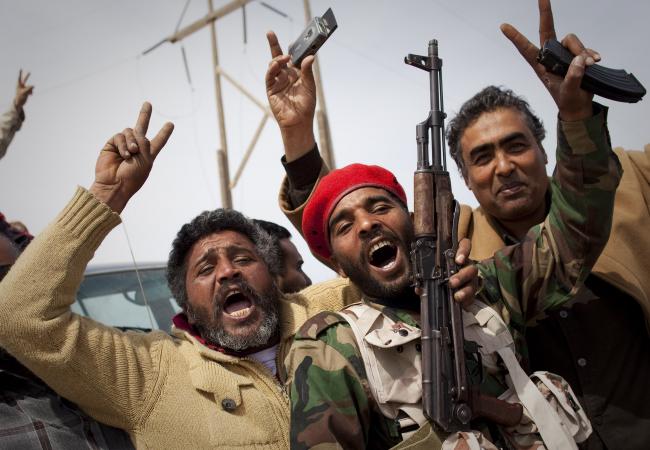
The move came after a plan was outlined by Libyan rebel leaders seeking to dispel doubts among Western powers about their capability to govern. The Libyan rebel representatives sent to Istanbul to make their case for recognition expressed exuberance after the announcement but also weariness and frustration at the limited help they have received.
With his hair matted in sweat and heavy bags under his eyes, Ali Tarhouni, the rebels’ minister of finance and oil, noted that the international recognition the rebels received Friday would not result in an immediate infusion of funds, which they desperately need.
“All it has brought is more pledges for money,” he said. “If we had as much money as we have had pledges these past few months, we would have no problems.”
Beside him, the rebels’ minister of information, Mahmoud Shammam, added that the opposition needs money but that it more desperately needs weapons, which most Western powers have refused to supply. The rebels might be barred from using money from frozen assets to buy weapons, he said.
News that the United States would recognize the rebel government as the legitimate authority in Libya spread quickly in the rugged desert mountains south of Tripoli, where rebel fighters have been battling Libyan troops. “We are very happy to hear this,” said Omar Gazayah, a teacher in the rebel town of Zintan who commands 230 fighters. “But we are waiting for actions, not just words and declarations.”
Gazayah said the rebels need money for fuel, medicine and weapons. “We hope this recognition means that America and NATO will put more pressure on Gaddafi — more pressure politically and with the military.”
So far, Kuwait and Qatar have given the rebels roughly $100 million. France on Friday renewed a previous pledge to unfreeze $250 million in assets in coming weeks for the rebels, and Italy pledged to unfreeze $100 million.
The United States did not pledge a specific amount, because the money is tied up in legalities, including U.S. and U.N. sanctions, U.S. officials said.
The United States could tell banks to transfer frozen assets directly to the Transitional National Council, but that could run into U.N. sanctions still in place. An alternative being considered by U.S. officials and Libyan rebels is using those assets as collateral for loans that rebels could use as funding.
The Obama administration’s announcement in Turkey drew immediate criticism from Rep. Michael Turner (R-Ohio), who has been among the most vocal Republicans on the Libyan conflict. “This is incredibly premature,” Turner said, citing concerns about the rebels’ loyalty to the United States. “I don’t believe the administration can even answer the question ‘Where will the money go?’ ”
Libyan rebel leaders in Turkey said in response that they are not asking for U.S. aid but for frozen assets that belong to the Libyan people.
According to Clinton, Friday’s move was meant as a clear signal of support for the rebels. For weeks, U.S. officials have stopped short of official diplomatic recognition because of concerns about whether a post-Gaddafi government set up by rebel leaders would be truly inclusive politically and geographically.
The United States and other foreign powers have worried that the oil-rich country could become embroiled in tribal conflicts or ethnic tensions once Gaddafi is no longer in power.
The United States changed its position after hearing a presentation in Turkey by Mahmoud Jibril, the transitional council’s foreign affairs representative, who described the rebels’ plans for governing a post-Gaddafi Libya.
According to Libyan council members, the plan includes having the rebels, now based in the eastern city of Benghazi, reach out to other regions of Libya not currently represented on the council. Together, they would form an interim government to rule in Gaddafi’s place and then guide the country through democratic reforms and, ultimately, the election of a new government. Because the council plans to form an interim governing body, it will not immediately be changing its name.
In Libya, rebel leaders complained Friday that NATO’s mandate of limited engagement should be expanded to allow allied warplanes to strike at Gaddafi’s forces in coordination with rebel attacks.
“NATO hits one tank and then goes home,” said Ibrahim Taher, a battalion commander in Zintan who lost eight fighters Wednesday. “NATO could change this war in a day if they wanted to.”
The question of how to oust Gaddafi also dominated the meeting in Istanbul. Foreign ministers debated the sincerity of Gaddafi emissaries who have recently declared that he is ready to step down. U.S. officials say that Gaddafi’s camp has sent contradictory signals and that they are not convinced he is prepared to give up power.
Leading up to the meeting, Turkey and the African Union proposed “road maps” for resolving the conflict. But foreign ministers from several countries, including Italy and France, said there are too many road maps and separate talks with Gaddafi emissaries. As a result, the international contact group agreed to make the U.N. special envoy to Libya, Abdul-Illah Khatib, the sole representative to communicate with Gaddafi’s government.
The session in Turkey is the fourth official meeting of the contact group. For the first time, China and Russia were invited to attend. But the two countries, which have been critical of the NATO-led campaign, declined.
Libya Rebels Get Formal Backing, and $30 Billion
ISTANBUL — The United States formally recognized the rebel leadership in Libya as the country’s legitimate government on Friday, allowing the rebel government access to $30 billion in Libyan assets held in the United States. It is not yet clear how and when the money would be released.
Secretary of State Hillary Rodham Clinton said at an international gathering held to discuss the Libyan conflict that Col. Muammar el-Qaddafi’s government no longer had any legitimacy, and that the United States would join more than 30 countries in extending diplomatic recognition to the main opposition group, known as the Transitional National Council.
“We will help the T.N.C. sustain its commitment to the sovereignty, independence, territorial integrity and national unity of Libya,” Mrs. Clinton said, “and we will look to it to remain steadfast in its commitment to human rights and fundamental freedoms.”
The decision by Washington not only increased diplomatic pressure on Colonel Qaddafi to step down, but also held the prospect of funneling money to rebels to propel an offensive that has proceeded in fits and starts.
Although American officials expressed hope that the newly recognized Transitional National Council would use the money for traditional public services — to pay for health care and electrical power, for example — one of the council’s immediate priorities is arming and training its fighters so they can finally defeat the forces loyal to Colonel Qaddafi.
But even a major increase in financing for the rebel war effort is not expected to yield immediate results on the battlefield, according to senior officials involved in the NATO-led air campaign against Colonel Qaddafi. The rebels are severely lacking in training as well as equipment, and NATO has been frustrated by the rebels’ inability to organize themselves into a force strong enough to topple the government, even with thousands of airstrikes on Colonel Qaddafi’s strongholds.
With a “no boots on the ground” policy in Libya, Western nations have found it hard to dislodge Colonel Qaddafi from power, as his forces have dug in around the capital, Tripoli, and other strategic cities where he retains at least some support among the civilian populations. Possibly reflecting their frustrations, several countries, including Britain and France, have sent arms, ammunition and other military supplies to the rebels in an effort to accelerate the development of their war-fighting capacity.
While the opening of the money spigots holds out some hope that the rebels can eventually turn the military tide against Colonel Qaddafi, it has also raised concerns about controls on the money and the potential for corruption.
“The Transitional National Council, in its discussions today, did pledge that this assistance would be delivered in a transparent manner and that it would indeed be inclusive in how it was delivered to the Libyan people,” said Mark C. Toner, the State Department’s deputy spokesman.
Mr. Toner acknowledged that there was “a sense of urgency” in transferring funds to the rebel group, and he stressed that the Departments of State and Treasury would keep watch to ensure “that accountability and transparency and monitoring is in place.”
In the early stages of the war, Western nations were reluctant to extend recognition to the rebels, uncertain of who they were and worried about possible ties to Al Qaeda and other militant groups. Over the months, though, those fears have been assuaged, and most nations are lining up behind the transitional government.
Mahmoud Shammam, a rebel spokesman, tried to address the concerns of Western nations, saying that the Transitional Council had “assured them in many ways that we are heading towards a democratic state, and with the support of allies, friends we would make that happen.”
Colonel Qaddafi lashed back in a speech on Friday night, dismissing the significance of the broad recognition of the rebel government.
“Trample on those recognitions, trample on them under your feet,” he told thousands of supporters in a speech broadcast to a televised rally in the coastal city of Zlitan, news agencies reported. “They are worthless.”
The Transitional Council issued a statement after the Istanbul meeting emphasizing Colonel Qaddafi’s loss of legitimacy. It said: “Qaddafi has not yet realized that Libyans have moved on. His rhetoric focuses on aggression and intimidation but no one is interested. We have had 42 years of looking over our shoulder in fear and now we want to face forwards in hope for a great Libya.”
One chronic problem for the anti-Qaddafi coalition is that its various members have not always spoken with one voice, diplomats said. The Istanbul meeting provided an opportunity, they said, to try to forge a consensus on the core elements of a Western negotiating position: what will happen to Colonel Qaddafi and his family, the mechanics of a political transition and the formation of a unity government.
The intention of the gathering was also to stop Colonel Qaddafi from trying to play one country off against another, by dealing separately with the French, the African Union, the Turks and the Russians, the diplomats said.
Some countries appear willing to have Colonel Qaddafi and his family remain in Libya if they give up power either to the rebel council or to a new, negotiated national unity government. In other words, there seems to be a new distinction being made between giving up power and going into exile.
While everyone speaks of Colonel Qaddafi’s “leaving” or “going,” they are much vaguer now about whether he must leave Libya, or whether leaving power is sufficient. The Libyan government has made similar overtures in the past, with the proviso that Colonel Qaddafi’s son Seif succeed his father — a condition that is absolutely unacceptable to the rebels, and to the Western powers.
How that fits with the indictment of Colonel Qaddafi on war-crimes charges by the International Criminal Court, or with the United Nations Security Council resolution calling on all member states to bring him to trial, is unclear. But as the war drags on in Libya, and Colonel Qaddafi remains in power in Tripoli, there is more pressure to find a negotiated solution.
Matters seemed simpler in the rebel-held city of Zintan, on the high plateau of the mountains in western Libya, where a group of elderly men sat in the shade beside the main mosque.
They were buoyed by the news from Istanbul, which all of them had heard.
“The recognition of America has opened a door for us, from Africa to the world,” said one of them, Mohammed el-Judaya.
Beyond the geopolitics, the men made it clear that they still had practical concerns. Much of the mountainous area is short of food, fuel and water, phone service has been mostly cut off and the Qaddafi forces are not far away. The war goes on, with life stalled and hardships ahead.
“We have no money for Ramadan,” which begins Aug. 1, said another man at the mosque, Muftah Benghazi. “This is difficult for us.”