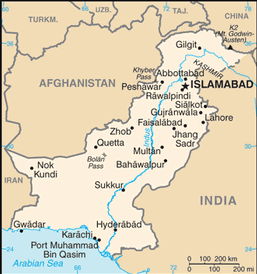
Malik also warned the US not to invade, following repeated US comments suggesting a ground operation may be in the offing, saying that Pakistan would “not allow the boots on our ground, never”and that cooperation with the US would continue so long as Pakistan’s sovereignty is respected.
The Obama Administration has dramatically ratcheted up the rhetoric with respect to the Haqqani Network over the past several weeks, dismissing public claims of responsibility for terrorist attacks by the Afghan Taliban to claim that they were secretly Haqqani plots. Though this first moved toward claims Pakistan wasn’t invading its own tribal areas often enough, it seems to have morphed into elaborate accusations of Pakistan as a state sponsor of terror.
With rising insurgent violence in Afghanistan – including a deadly 20-hour assault on the US Embassy in Kabul, which the US blamed on the Haqqani network – the US is starting to lose its grip, especially as domestic pressure to bring the troops home increases. Pointing the finger at Pakistan after years of silence on the issue is a sign that the chips are down and so the blame game has become an attractive way to justify more militarism.
Experts have suspected parts of the Pakistani government of having ties to militants for years, but the US has refused to offer any evidence in response to Pakistani requests to do so. What ties there are go back to Reagan administration policy of funneling money and weapons through Pakistan to Islamic fighters in Afghanistan against the Soviets. Some have pointed out that Pakistan’s reluctance to attack is based on a perception of national interest that the Haqqanis pose no threat to them and may in fact be useful to counter Indian influence in Afghanistan after American forces drawdown.
That the US government would begin to express frustration with Pakistani policy is rather ironic. For the past decade, the US has been throwing mountains of economic and military aid to the corrupt regime for cooperation in the fight against anti-American terrorism. During that time, the US has repeatedly violated Pakistani sovereignty without permission, conducting kill/capture operations with special operations forcesan undisclosed number of times. Additionally, the drone program has been expanded many-fold, resulting in untold numbers of civilians casualties and increasing instability along Pakistan’s border with Afghanistan.
Mullen and others have accused the Pakistanis of conducting a proxy war through the Haqqanis in Afghanistan, claiming they’re supporting terrorism. Meanwhile, the US has been training, funding, and equipping a terrorist proxy force of their own in Afghanistan called the Afghan Local Police, recently accused by Human Rights Watch of “serious abuses, such as killings, rape, arbitrary detention, abductions, forcible land grabs, and illegal raids.” When the Pakistanis do it, the US calls it terrorism. When the US does it, it’s counter-terrorism.
“Only a decision to break with this policy can pave the road to a positive future for Pakistan,” Mullen said. The message to the Pakistanis is essentially a demand to obey the United States, or else. It has perhaps not occurred to national security planners that the whole mess could be moot if the US would simply pull out of Afghanistan, cutting their losses in a purposeless fight.