
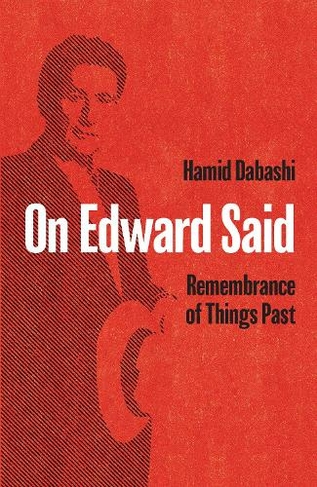
By Hamid Dabashi, Haymarket Books, 2020, paperback, 250 pp. MEB $19.95
Reviewed by Walter L. Hixson
 Hamid Dabashi has produced an engaging autobiographical tribute to his close friend and colleague at Columbia University, the renowned theorist and Palestinian activist Edward Said, who died in September 2003 at age 67. Dabashi aptly describes the book as “At once a political and scholarly reminiscence about Said.”
Comprised of a sprightly collection of memories, interviews, travelogues, short essays and more extended philosophical treatises, the book assesses Said’s political thought and activism as well as Dabashi’s own not inconsiderable intellectual contributions. Dabashi, an Iranian-born author, thinker, and Al Jazeera columnist, treasured Said as a close friend and intellectual confidante who “was always a catalyst in my thinking.”
On Edward Said: Remembrance of Things Past will be accessible and rewarding to readers who are new to the subject as well as those already familiar with Said and his work. As Dabashi points out, Said was first and foremost a passionate, unconditional and lifelong advocate for the liberation of his native Palestine. That cause like no other fueled Said’s “towering ability to speak truth to power.”
In addition to the lifelong advocacy for his native land, Said established a reputation as a powerful intellectual with the publication of his seminal work Orientalism in 1978. In that study Said brilliantly theorized the relationship between knowledge and power in Western representations (as opposed to the realities) of the colonial world and specifically the Arab-Islamic world. Like all intellectuals, Said drew on the work of previous thinkers—especially Antonio Gramsci and Michel Foucault—in establishing Orientalism as an enduring critique and a foundational text on postcolonial thought.
In Representations of the Intellectual (1994) and other works, Said also ruminated revealingly on the challenges of the “exilic intellectual.” Though marginalized both literally and figuratively, the exiled intellectual nonetheless must persist in the obligation to speak truth to power. As Dabashi points out, after Said’s birth in Palestine and childhood in which he received a British education in Egypt, he moved to New York City where he “planted the defiant character of the exilic intellectual right in the middle of the most conceited public space in the very heart of an Empire.”
Dabashi deeply admires Said not only for his intellectual and political contributions but also for his friend’s “intimate humanity, ordinary simplicity” as well as his “sweet, endearing, disarmingly embracing character.” Dabashi links Said with a rarefied handful of legendary intellectuals and revolutionaries notably Aimé Césaire, Frantz Fanon and Rosa Luxemburg. By contrast, Dabashi does not shy away from calling out the villains of the Said story, both opponents of Palestinian liberation and of Said personally. These include Fouad Ajami, Dinesh D’Souza, Alan Dershowitz, Thomas Friedman, and Said’s nemesis Bernard Lewis. In a closing essay, Dabashi dismisses the latter—a former Princeton professor, proponent of apartheid Israel, and a man who was hostile to both Said and his cause—as a mere “ideological functionary,” the equivalent of “a British colonial officer writing intelligence for his fellow officers on how to rule the Muslim word better.”
Unlike Lewis, Said’s stature and the significance of his intellectual contributions have only grown since his death. He will remain a towering figure for “his enduring ideas of contrapuntal thinking, of secular humanism, of his magisterial critique of Orientalism as the modus operandi of knowledge and power, and of his monumental works on culture and imperialism.” But above all, Said’s devotion to Palestine has cemented a legacy as “the most significant spokesman of the Palestinian cause abroad.”
Said is no longer with us, but that legacy is very much alive—and very well served by the memories and verbal artistry of Hamid Dabashi.


