OSLO — A lawyer representing the anti-Muslim extremist who carried out the massacre in Norway sought to fill in some of the wide gaps in public knowledge about his client on Tuesday, portraying him as a “very cold” person who lived in his own world, buttressed by drugs and the belief that he was a warrior doomed to die for a cause others did not comprehend.
The lawyer, Geir Lippestad, declined to say whether his client, Anders Behring Breivik, 32, would plead insanity as a defense when his case comes to trial. However, he told a news conference, “this whole case has indicated that he is insane.”
Police and court officials have said Mr. Breivik has admitted to detonating a large bomb in Oslo that killed eight people and then killing 68 mainly young people at a summer camp run by the ruling Labor Party on the nearby island of Utoya. The attacks on Friday amounted to one of the worst massacres in postwar Europe.
“He believes that he is in a war and in a war you can do things like that,” Mr. Lippestad said.
“He is in a bubble,” Mr. Lippestad said, adding that Mr. Breivik took drugs to “be strong, to be efficient, to be awake.” The lawyer did not say which drugs his client had used.
He called Mr. Breivik “very cold.”
Mr. Breivik was arraigned Monday on terrorism charges and is being held in solitary confinement. The lawyer, who said he had met his client three times, most recently on Monday, said Mr. Breivik would undergo medical examinations to assess his mental state.
“I will look into the papers when they are ready,” he said.
The lawyer said the police had told him Mr. Breivik was cooperating with them, but has refused to answer questions about his assertion that he had accomplices in at least two other “cells” in Norway and “several abroad.”
“He tells what he has done, everything he has done, but he won’t say anything about other cells,” the lawyer said.
“He has a view of reality that is very difficult to explain,” Mr. Lippestad said. “He says that the rest of the world doesn’t understand his point of view, but in 60 years time, they’ll understand him.”
“He believes someone will kill him,” Mr. Lippestad said, adding that Mr. Breivik had expected to be killed during the attacks on Friday or on his way to court on Monday. “I cannot describe him because he is not like anyone,” the lawyer said.
Asked if the rampage was aimed at the Labor Party, or at Muslim immigrants, Mr. Lippestad said: “This was an attack on the Labor Party.”
The lawyer acknowledged that he was himself a member of the party. Mr. Breivik did not know of his lawyer’s political affiliation, he said.
Earlier on Tuesday, the Norwegian authorities defended the police response to the attacks, which Mr. Breivik said on Monday he launched to save the country from ruin. He also denied in his first court appearance that he was guilty of any crime and hinted for the first time that he had collaborators.
The police took over an hour to reach the island of Utoya on Friday with a police SWAT team apparently traveling by road and boat, even though a television news crew had been able to fly over the island in a helicopter before Mr. Breivik gave himself up.
On Tuesday, Justice Minister Knut Storberget called the police work on the day of the rampage “fantastic,” news reports said, and suggested that this was not the right time to question the way security forces responded.
“It is very important that we have an open and critical approach, but there is a time for everything,” Mr. Storberget said after talks with Oslo’s police chief, Reuters reported. The minister also denied that police had ignored threats posed by right-wing extremists. “I reject suggestions that we have not had the far right under the microscope,” he said.
Carol Sandbye, a spokeswoman for the Oslo police, said on Tuesday that prosecutors would consider charging Mr. Breivik with crimes against humanity. That offense carries a maximum penalty of 30 years, compared to 21 years for the current charges of terrorism.
The developments came a day after Judge Kim Heger summarized remarks by Mr. Breivik at a closed-door custody hearing.
The police said later they were not ruling out the possibility that Mr. Breivik’s claim of accomplices, which he described as “two more cells” in an organization he called Knights Templar, was accurate. But they also noted that he had previously told them he had acted alone.
Some security analysts, like Tore Bjorgo, a professor at the Norwegian Police University College and an expert on right-wing extremism, were also skeptical, questioning whether the Knights Templar organization that Mr. Breivik claimed in his manifesto to have helped form in 2002 really existed or was simply an effort to claim a more elaborate history and role.
Mr. Breivik became much more extreme in the last two or three years, Mr. Bjorgo said. “That’s why I have some real doubt about this Templar claim in 2002,” he said. “It doesn’t correspond to his history. I’m not convinced it’s a real organization. It could be a fantasy or a threat, or it could be to try to show that he is part of a larger network.”
Mr. Breivik’s brief appearance on Monday at an Oslo courthouse came as Norwegians were still grappling with the enormity of the attacks.
By Monday evening, at least 100,000 mourners had converged on Oslo to honor the victims and repudiate the suspect’s ideology of hatred toward Muslims and advocates of multiculturalism, who he said were ruining Norway and threatening Western European civilization.
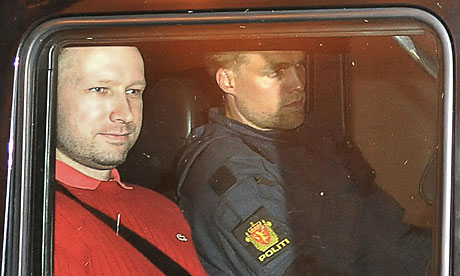
The judge ordered Mr. Breivik held in jail for eight weeks, half of it in isolation, with no access to the outside except through his lawyer. The judge refused to open the hearing to the public. Mr. Breivik, who had asked for an open hearing to explain his actions and his views about Muslims and to wear some sort of uniform, was denied on both counts. He was photographed in a car leaving the hearing wearing a red sweater embossed with a Lacoste alligator emblem.
Judge Heger said Mr. Breivik had been charged with “acts of terrorism,” including an attempt to “disturb or destroy the functions of society, such as the government” and to spread “serious fear” among the population. At a televised news conference, the judge said Mr. Breivik had acknowledged carrying out the attacks but had pleaded not guilty, because he “believes that he needed to carry out these acts to save Norway” and Western Europe from “cultural Marxism and Muslim domination.”
The police also revised the death toll downward to 76 from 93, saying that eight people were now known to have died in the bomb blast in central Oslo, one more than before, and 68 on the island of Utoya, instead of 86. The police said they had been too occupied with searching for the dead and missing to confirm their counts, and to prevent further confusion, they said, they declined to provide any figure for those still missing.
Legislators said a list of the dead might not be available until next Monday or Tuesday, when they planned to hold a memorial ceremony, followed by funerals all over Norway.
Mr. Breivik’s estranged father, a retired career Norwegian diplomat, expressed shock and despondency over the news that his son was a mass killer, in an interview published by Expressen, a Swedish tabloid, done from southern France, where he lives. The father, Jens David Breivik, said he was overcome with grief for the victims, might never return to Norway and hoped that others would not blame him for his son’s actions. “He should have taken his own life, too,” the father said. “That’s what he should have done.”